Pages

Sunday, May 31, 2015

Dispute on the Trinity


Andrea del Sarto (1486 - 1530)
Disputa sulla Trinità / Debate on the Trinity
1517
Oil on wood panel
232 x 193 cm
Galleria Palatina e Appartamenti, Palazzo Pitti, Florence


The saints in contemplation are Saints Augustine, Laurence, Peter Martyr, Francis, Sebastian and Mary Magdalene

It was commissioned for the Peri Chapel in the Chiesa di San Gallo in Florence

The Peri family had distinguished itself in republican service. The so called "inventor" of opera Jacopo Peri (1561 - 1633) was (to be) a member of this family

In 1529 when the church was destroyed in the Siege by Charles V,  it was transferred to the Church of San Jacopo de' Fossi in Florence where it stayed for about 100 years before falling into the ownership of the Medici family

The Church of San Gallo was with the Augustinian Order hence the significance of St Augustine and one of St Augustine`s great field of study: The Trinity

The models for the work are two works by Raphael: The Disputa of the Eucharist (1508) in the Stanze Vaticane and his Ecstasy of Saint Cecilia (1514)

Del Sarto produced two other works for this Church: the Annunciation and Noli me tangere (1510)

One sees the Trinity and a variety of saints of different times, situations and backgrounds but all of major importance

In De Trinitate, VIII, 8, 12, Saint Augustine wrote:
“If you see charity, you see the Trinity”
As Pope Leo XIII said (see below),  the worship paid to the saints and angels, to the Mother of God, and to Christ Himself, finally redounds to the honour of the Blessed Trinity.

In Divinum Illus Munus, (1897) Pope Leo XIII with reference to St Augustine tried to explain some aspects of the Catholic Doctrine of the Trinity:

"The Catholic Doctrine of the Blessed Trinity 
3. Before We enter upon this subject, it will be both desirable and useful to say a few words about the Mystery of the Blessed Trinity. 
This dogma is called by the doctors of the Church "the substance of the New Testament," that is to say, the greatest of all mysteries, since it is the fountain and origin of them all. In order to know and contemplate this mystery, the angels were created in Heaven and men upon earth. In order to teach more fully this mystery, which was but foreshadowed in the Old Testament, God Himself came down from the angels unto men:
"No man bath seen God at any time; the only begotten Son, who is in the bosom of the Father, He hath declared Him" (John i., 18). 
Whosoever then writes or speaks of the Trinity must keep before His eyes the prudent warning of the Angelic Doctor: 
"When we speak of the Trinity, we must do so with caution and modesty, for, as St. Augustine saith, nowhere else are more dangerous errors made, or is research more difficult, or discovery more fruitful" (Summ. Th. la., q. xxxi. De Trin. 1 L, c. 3). 
The danger that arises is lest the Divine Persons be confounded one with the other in faith or worship, or lest the one Nature in them be separated: for 
"This is the Catholic Faith, that we should adore one God in Trinity and Trinity in Unity." 
Therefore Our predecessor Innocent XII, absolutely refused the petition of those who desired a special festival in honour of God the Father. For, although the separate mysteries connected with the Incarnate Word are celebrated on certain fixed days, yet there is no special feast on which the Word is honoured according to His Divine Nature alone. 
And even the Feast of Pentecost was instituted in the earliest times, not simply to honour the Holy Ghost in Himself, but to commemorate His coming, or His external mission. 
And all this has been wisely ordained, lest from distinguishing the Persons men should be led to distinguish the Divine Essence. Moreover the Church, in order to preserve in her children the purity of faith, instituted the Feast of the Most Holy Trinity, which John XXII. afterwards extended to the Universal Church. 
He also permitted altars and churches to be dedicated to the Blessed Trinity,and, with the divine approval, sanctioned the Order for the Ransom of Captives,which is specially devoted to the Blessed Trinity and bears Its name. 
Many facts confirm its truths. 
The worship paid to the saints and angels, to the Mother of God, and to Christ Himself, finally redounds to the honour of the Blessed Trinity. In prayers addressed to one Person, there is also mention of the others; in the litanies after the individual Persons have been separately invoked, a common invocation of all is added: all psalms and hymns conclude with the doxology to the Father, Son, and Holy Ghost; blessings, sacred rites, and sacraments are either accompanied or concluded by the invocation of the Blessed Trinity. 
This was already foreshadowed by the Apostle in those words: 
"For of Him, and by Him, and in Him, are all things: to Him be glory for ever"(Rom. xi., 36)
thereby signifying both the Trinity of Persons and the Unity of Nature: for as this is one and the same in each of the Persons, so to each is equally owing supreme glory, as to one and the same God. 
St. Augustine commenting upon this testimony writes: 
"The words of the Apostle, of Him, and by Him, and in Him are not to be taken indiscriminately; of Him refers to the Father, by Him to the Son, in Him to the Holy Ghost" (De Trin. 1. vi., c. 10; 1. i., c. 6). 
The Church is accustomed most fittingly to attribute to the Father those works of the Divinity in which power excels, to the Son those in which wisdom excels, and those in which love excels to the Holy Ghost. Not that all perfections and external operations are not common to the Divine Persons; for "the operations of the Trinity are indivisible, even as the essence of the Trinity is indivisible" (St. Aug., De Trin., I. 1, cc. 4-5); because as the three Divine Persons "are inseparable, so do they act inseparably" (St. Aug., i6.). 
But by a certain comparison, and a kind of affinity between the operations and the properties of the Persons, these operations are attributed or, as it is said, "appropriated" to One Person rather than to the others. 
"Just as we make use of the traces of similarity or likeness which we find in creatures for the manifestation of the Divine Persons, so do we use Their essential attributes; and this manifestation of the Persons by Their essential attributes is called appropriation" (St. Th. la., q. 39, xxxix., a. 7). 
In this manner the Father, who is "the principle of the whole God-head" (St. Aug. De Trin. 1 iv., c. 20) is also the efficient cause of all things, of the Incarnation of the Word, and the sanctification of souls; "of Him are all things": of Him, referring to the Father. 
But the Son, the Word, the Image of God is also the exemplar cause, whence all creatures borrow their form and beauty, their order and harmony. He is for us the Way, the Truth, and the Life; the Reconciles of man with God. "By Him are all things": by Him, referring to the Son. 
The Holy Ghost is the ultimate cause of all things, since, as the will and all other things finally rest in their end, so He, who is the Divine Goodness and the Mutual Love of the Father and Son, completes and perfects, by His strong yet gentle power, the secret work of man's eternal salvation. "In Him are all things": in Him, referring to the Holy Ghost."

Saturday, May 30, 2015

Francesco Hayez (1791-1882)


Francesco Hayez (1791-1882)
S Michele Arcangelo Traffige Il Drago/ St Michael Archangel Slays The Dragon
1839
Oil on canvas
Parrocchia Sant'Andrea Apostolo, Iseo, Brescia


Hayez was the most important figure in the transition from Neoclassicism to Romanticism in Italian painting

His Romantic leanings come out mainly in subject-matter rather than in technique, 

He trained in Rome in the circle of Canova and Ingres. 

He painted religious, historical, and mythological works in a vein owing something to Delacroix and Delaroche, and Ingres

Ferrari wrote of the picture of St Michael:
".. Ecco uno Spirto / Velocissimo scendere dall’etere / Col dardo in mano fiaccator possente / Dell'altero Satanno: oh son divine / Quelle angeliche forme!"

Below is the depiction of the Gospel of John (8: 3-11) in what might appear to be somewhat in the style of the German Nazarenes:


Francesco Hayez (1791-1882)
Christ and the Woman Taken in Adultery
1841
Oil on canvas
43.2 x 53.9 cm
Walters Art Museum, Baltimore


In the next year we find another work depicting Samson`s defeat of the Lion now in Florence


Francesco Hayez (1791-1882)
Sansone e il leone atterrato
Samson and the Lion thrown to the Ground
1842
Oil on canvas
210 x 162 cm
Galleria d'Arte Moderna, Florence

The full title of the work is:
Sansone, atterrato un giovane leone, medita di farlo in brani, provando così il dono della prodigiosa sua forza 
The work was commissioned by Ambrogio Maria Martiniano Uboldo (1785 - 1865) and then exhibited at the Brera

Uboldo was a patron of Hayez. He was a soldier under Napoleon and then under the Austrians

A great part of the income in terms of his Will was left for a Hospital for the poor

The work has a martial feel


The last religious masterpiece by Hayez was one of Christ in the Passion:


Francesco Hayez (1791-1882)
Ecce Homo
c.1870 - 4
Oil on canvas
128 cm x 210 cm
Galleria dell’Accademia Tadini di Lovere,  Brescia 

It was done while not in good health

However it was point of honour to complete it

He had promised his grandson

It was, he wrote a "puntiglio di mantenere la promessa che ho dato a mia nipote di fare avere il dipinto l'Ecce Homo pei primi del venturo Agosto". 

Wednesday, May 27, 2015

Saints Flora and Lucilla


Master of Saints Flora and Lucilla, active ca. 1300 - 1340
Saint Flora
ca. 1310
Tempera on panel
90.4 x 55.4 cm
Yale University Art Gallery, New Haven, Ct


Master of Saints Flora and Lucilla, active ca. 1300 - 1340
Saint Lucilla
ca. 1310
Tempera on panel
90.3 x 54.4 cm
Yale University Art Gallery, New Haven, Ct


The cult of Saints Flora and Lucilla was strong in Tuscany especially around Arezzo

They appeared to have died martyrs` deaths circa AD 260-265 during the reign of Gallienus

They were two sisters who were virgins who were martyred along with Eugenius, Theodore, Antonius  and another 18 companions

Their feast day was 29th July until their names were expunged from the Roman calendar in 2001 on the basis that their stories were probably a medieval legend

About AD 851 their relics were taken from Ostia to Arezzo by John, Bishop of Arezzo where he placed them in a Benedictine abbey

He later built a church on the Titano (Torrita) hill overlooking the town and an  abbey to house the remains

The church (La Badia delle Sante Flora e Lucilla)was rebuilt in the 1560s by Vasari 

The presbytery is dominated by the monumental altar built by Vasari (a native of Arezzo) for the chapel of his family in the parish church of Santa Maria in 1563 and moved here in 1865. 

A masterpiece of baroque artifice is the false dome, painted on canvas by the celebrated Jesuit brother Andrea Pozzo (1642-1709)  in 1702 and placed above the main altar

In the 9th century their stories were memorialised in The Passio. however it simply copies verbatim the stories of other saints and martyrs with some insignificant changes

The relics are still in the Badia but housed in the altar dedicated to  Saint Rita. 

The cult did spread throughout Tuscany and also into France and Spain

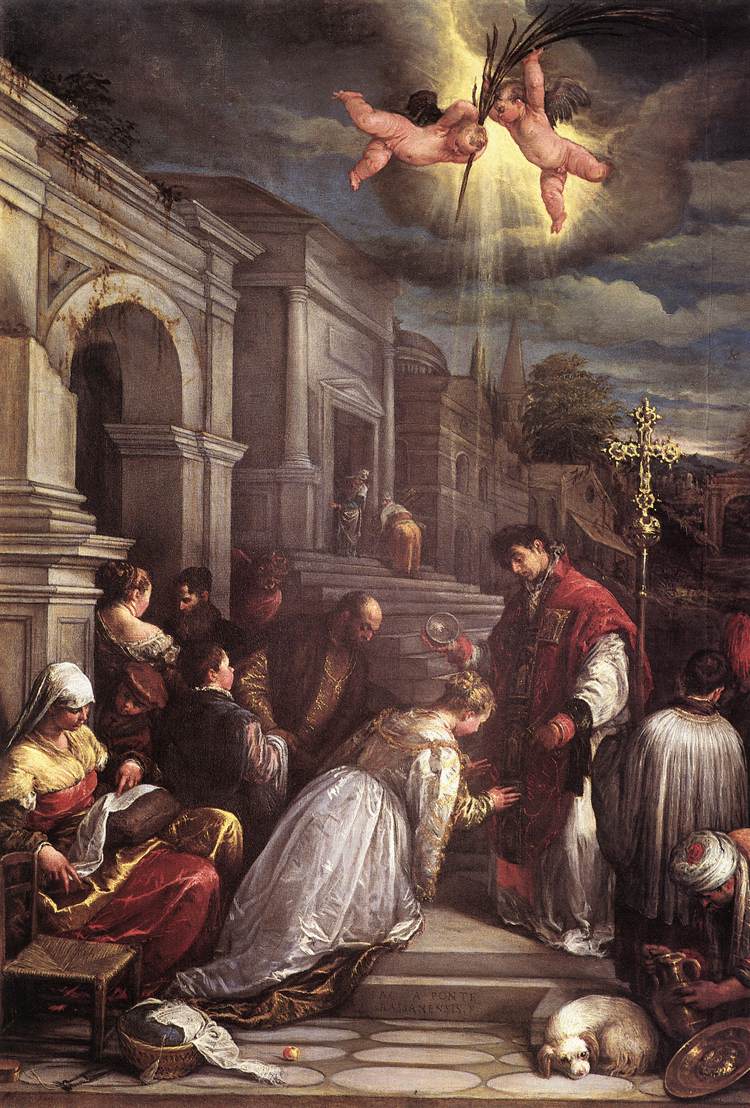
Here is a Mannerist version of the Baptism of St Lucilla by St Valentine by da Ponte:


Jacopo Bassano (Jacopo da Ponte) (1510-1592)
St Valentine Baptizing St Lucilla
1575
Oil on canvas
183.5 x 129.5 cm
Museo Civico, Bassano del Grappa


Bassano has conflated a number of stories and produced a parable on Light

Lucilla as painted is the daughter of a Roman noble who seeks Baptism from the hands of St Valentine

She is blind

On being baptised her sight is restored

Valentine and Lucilla are subsequently martyred

As might be expected from an artistic master of the Veneto and pupil of Titian the light effects in the painting dazzle the viewer reinforcing the theme of the painting

By the early 1560s Bassano freed himself from Mannerist preoccupations, returning to a new objectivity and classicism with compositions based upon the unifying power of light. 

In Baptism we become Children of God, the brothers and sisters of Christ, the Light of the World

Out of the darkness Lucilla will step into the Light and will never be the same again

A religious man and a painter of many religious works, da Ponte is said to have stated:
"Sono di fede et religione cristiana, e chi si ingana, suo dano” ("I am of the Christian faith and religion, and if somebody believes the contrary, he is wrong and it is his problem")


Friday, May 22, 2015

The Whitsun Cassone


Italian School
The Whitsun Cassone
Oil on panel
81 x 198 cm
Campion Hall, University of Oxford


Campion Hall in Oxford was established by the Society of Jesus in 1896 as a private Hall of the University


This cassone is but one

A cassone (or forziere) was a type of decorated wooden dowry chest  from central Italy, used extensively from the end of the fourteenth, through the fifteenth and sixteenth centuries. 

The construction and decoration of cassoni closely parallel methods used for contemporary altarpieces

It took about a month to paint a cassone front

According to Vasari, the Florentine Apollonio di Giovanni di Tomaso (1414 – 1465) specialised in the painting of such cassoni

Their decoration changed from painted design in the fifteenth and early sixteenth centuries to carving (sometimes partially gilt) in the second half of the sixteenth century.

This cassone  depicts the descent of the Holy Spirit at the First Pentecost or Whitsunday as described in the Acts of the Apostles, 2: 1–4.

Mary is at the centre of the gathering of the Apostles and disciples in Jerusalem

"1 When the time for Pentecost was fulfilled, they were all in one place together. 
2 And suddenly there came from the sky a noise like a strong driving wind, and it filled the entire house in which they were. 
3 Then there appeared to them tongues as of fire, which parted and came to rest on each one of them. 
4 And they were all filled with the Holy Spirit and began to speak in different tongues, as the Spirit enabled them to proclaim"
However there are some differences

The setting is in the open air and not in a house

The tongues of fire are not yet on the people assembled

The scene is the one before the first proclamation (or kerygma) by St Peter of the messianic significance of the death and resurrection of Jesus:
"Exalted at the right hand of God, he received the promise of the Holy Spirit from the Father and poured it forth, as you (both) see and hear ... 
Therefore let the whole house of Israel know for certain that God has made him both Lord and Messiah, this Jesus whom you crucified."

Wednesday, April 22, 2015

Pius XI Art Historian


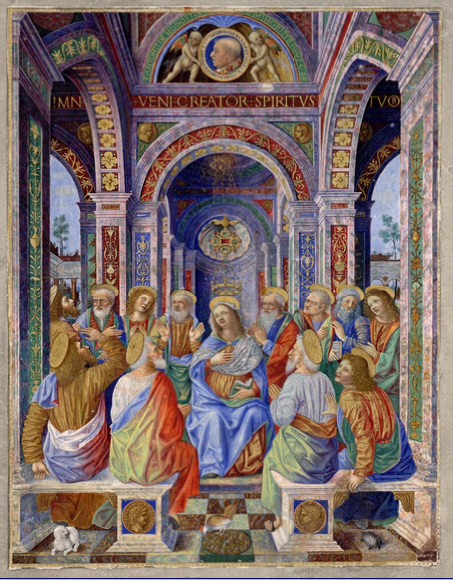
Fra Antonio da Monza (active 1492/1503 ) 
Pentecost
1492 - 1503
Miniature on Parchment
33,5 x 27,7 cm
Albertina Museum, Vienna, Austria


Pope Pius XI (Ambrogio Damiano Achille Ratti) (31 May 1857 – 10 February 1939), was Pope from 6 February 1922 to his death in 1939.

Before he became a diplomat, he was a scholar of no mean repute

He was at the Ambrosian Library (the Biblioteca Ambrosiana) in Milan, from 1888 to 1911. He was made Prefect in 1907

In 1911, at Pope Pius X's invitation, he moved to the Vatican to become Vice-Prefect of the Vatican Library, and in 1914 was promoted to Prefect.

While in Milan, he  transcribed and published codices and rare archival documents. He reordered the Library of the Certosa di Pavia, the Library and the Pinacoteca Ambrosiana,as well as  the Museo Settala

He recovered and restored the codices and manuscripts of the Chapter of Milan Cathedral which had been damaged by fire

As Pope he founded the new Vatican Pinacoteca, in a special building near the new entrance to the Museums. He also founded the Missionary-Ethnological Museum in 1926, arranged on the upper floors of the Lateran Palace before it was moved elsewhere

Occasionally one comes across articles and works from his early period in Milan

There was an interesting debate in which he took part concerning the Lombard miniaturist and Franciscan Fra Antonio da Monza (active about 1480 - 1505)

His Pentecost (above)  is now in the Albertina

It was for a  Festmissale for the then  Pope Alexander VI, the Borgia Pope whose features also adorn the work. The choir books were a gift by the Pope for Santa Maria in Aracoeli and  the Observant Franciscans within the Church

Fra Antonio appears to have been a member of the Observant Franciscans

Antonio's artistic style was influenced by the art of Leonardo da Vinci. Scholars have attributed several liturgical books, as well as some miniatures in the Sforza Hours and in Antonio Minuti's Life of Muzio Attendolo Sforza, to him. Minuti was a notary and chancellor to the Sforza family

Here are some works where positive attributions to him have been made


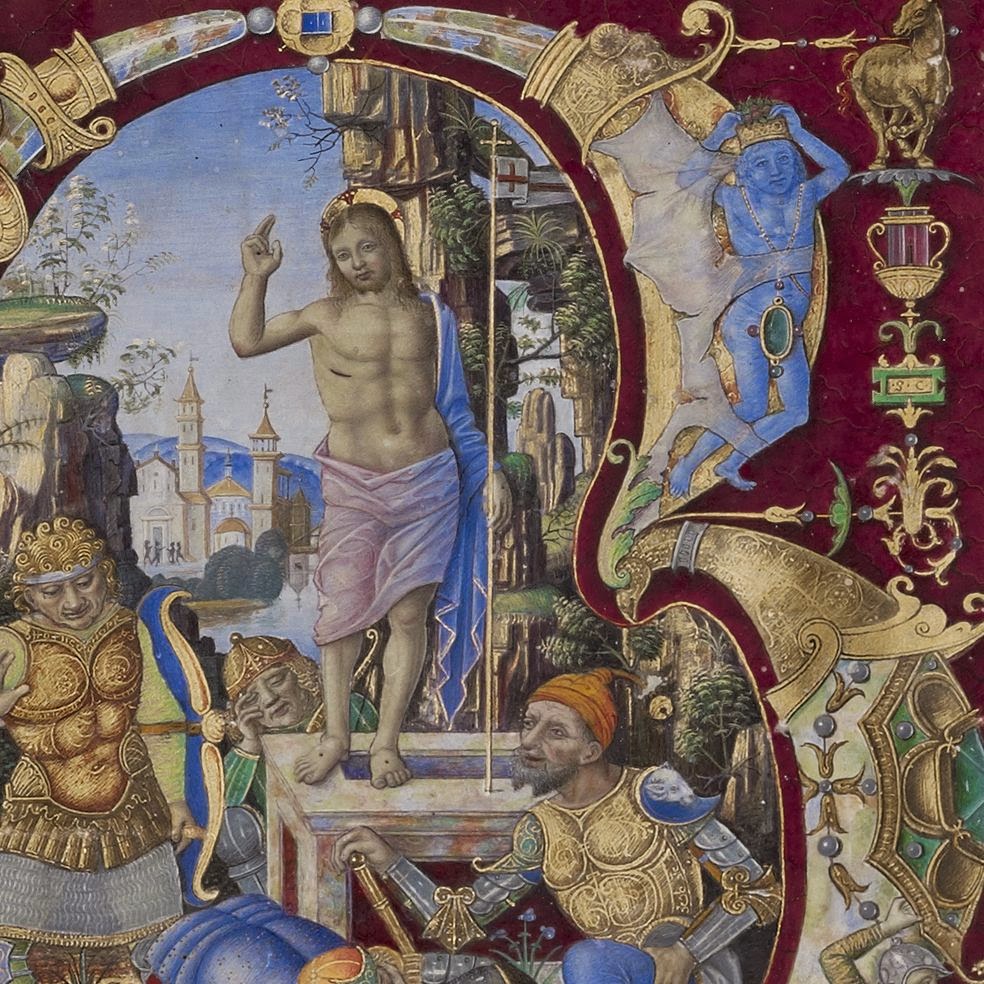
Antonio da Monza (active about 1480 - 1505)
Initial R: The Resurrection
From Introit for Easter, Gradual:  Ms. Ludwig VI 3 (the Ludwig Aracoeli Manuscript,)
late 15th or early 16th century
Tempera colours, gold leaf, and ink on parchment bound between original wood boards covered with brown leather
64.1 x 43.5 cm (25 1/4 x 17 1/8 in.)
The J. Paul Getty Museum, Los Angeles


Antonio da Monza (active about 1480 - 1505)
The Crucifixion
c. 1492 - 4
From The Christmas Missal of Pope Alexander VI Ms. Borg. Lat. 425, folio 38v
Missa in Nativitate Domini Nostri Iesu Christi, hora tertiarum Pontifice Maximo celebrante
 Gouache, ink, and gold on vellum,
46.5 x 32.4 cm
Biblioteca Apostolica Vaticana. Vatican


The work and identity of Fra Antonio da Monza was only revived by researchers in the late nineteenth century, but little is known about his life or career

He is a mysterious figure

Art historians have attempted to piece together the oeuvre of Fra Antonio da Monza or cited individual works as successful examples of hybrid compositions 

One of these historians was the great German art historian Paul Kristeller (1863 - 1931) not to be confused with the great Columbia University scholar of the Italian renaissance, Paul Oskar Kristeller (1905-1999). {But of course they often are and the works of the earlier are often shown as works of the latter)

Kristeller as one of the leading art historians of the Italian Renaissance became interested in Fra Antonio

In 1901 he published a monograph Fra Antonio da Monza, incisore  in  Rassegna d'arte I (1901), pp 161-164 and wondered whether on the basis of two hitherto unattributed prints he discovered in Milan whether Fra Antonio had also been an engraver and printer

The evidence he adduced was slight and unconvincing but his view was taken up by some art establishment figures such as S. Arthur Strong, Librarian to the House of Lords and at Chatsworth, Sir Sidney Colvin (Keeper of the Department of Prints and Drawings at the British Museum) and Arthur Mayger Hind (later Keeper of the Department of Prints, British Museum) 

They also prayed in aid the views of the Biblioteca Ambrosiana and Monsignor Ratti

This seems to have been the final straw


He poured cold water on the idea, demolished the reasons given for the attribution and clinically advanced reasons why on the basis of the existing evidence Fra Antonio could not have been the engraver

Why the bother ?

Possibly a number of reasons can be envisaged

He wanted the truth to come out and be established according to the hard facts and evidence and be established in a positive rational way and not on the basis of pure subjective opinion and reverie

The thesis which he attacked ignored the possibility or even probability that around 1500 there was in his beloved Milan, his beloved Lombardy a mature and thriving market for art filled with mature and sophisticated artists and their customers

For Kristeller was firmly of the view that the peak of Italian woodcut was to be found in Venice and Florence and that outwith Rome and Naples there were no local schools of woodcut in Italy

Of course he also wished to guard the academic reputation of the highly regarded Biblioteca Ambrosiana

Here is his article with the illustrations:


A work of great erudition and scholarship but both are lightly worn by the very learned author

This was written before the time when academics had research assistants and students who did first or second drafts

One notes the pointed ending with the Classical allusion

The reply came from Kristeller in his Die Lombardische Graphik der Renaissance. Berlin: Bruno Cassirer, 1913.  - in a large passage and a footnote:


The First World War put an end to the debate

However in the 1940s and beyond Father Ratti`s view held sway and Kristeller`s was overruled


Sunday, April 19, 2015

St Teresa de Jesús 2015


Anonymous
Canonisation of St Teresa in Rome 1622 
17th century
Oil on canvas
165 x 211 cm
Museo Carmelitano Teresa de Jesús. Monasterio de la Anunciación de Nuestra Señora. MM. Carmelitas Descalzas. Alba de Tormes, Salamanca, Spain


The ceremony of canonisation took place on March 12, 1622 in the presence of Pope Gregory XV

In front of the Pope is depicted  his nephew Cardinal Ludovico Ludovisi  who was the promoter of the cause of canonisation


Gregorio Fernández 1576 - 1636
Saint Teresa de Jesús 
Circa 1615
Polychrome statue
160 x 74 x 75 cm
Santuario de Nuestra Señora del Carmen  Extramuros. Valladolid


Gregorio Fernández (1576 – 22 January 1636) was a Spanish Baroque sculptor of the Castilian school of sculpture

The most important collection of his work is in the National Sculpture Museum in Valladolid 

He moved to Valladolid which was then the court of the Kings of Spain , between 1601 and 1606 

Another sculpture of the saint by the sculptor is preserved in the Museum:(below)


Gregorio Fernández 1576 - 1636
Saint Teresa de Jesús 
Circa 1625
Polychrome statue
172 x 103 x 85 cm
Museo Nacional de Escultura, Valladolid

The work was commissioned by the Convento de Nuestra Señora del Carmen (Carmelitas Calzados), Valladolid around the time of the canonisation of the saint

In her left hand she  holds an open book inscribed, in which the name of her confessor, Pedro de Alcántara is included. 

Here we see the dynamic saint but also one who meditates and writes


Luca Giordano (1634 – 12 January 1705)
The Transverberation of Saint Teresa
Circa 1664 
Oil on canvas 
202 x 157 cm
MM. Discalced Carmelites. Penaranda de Bracamonte, Salamanca

This work was commissioned by the Spanish diplomat Don Gaspar de Bracamonte 3rd Count of Peñaranda (c.1595 – December 14, 1676) for the Convent of the Incarnation of Discalced Carmelites of Penaranda de Bracamonte (Salamanca)  where the work still  resides

The Neapolitan Giordano was nicknamed 'Luca fa Presto' (Do it quick, Luke) by his contemporaries because of his enormous output and versatility. 

He studied in Naples, Rome, Florence and Venice where he copied works by Tintoretto and Veronese whose style clearly influenced this composition.

The work commemorates the famous event which  happened to the saint in 1559 at the Monastery of the Incarnation in Avila

All images (except from the Museum) are from a websie of an important Spanish exhibition to celebrate the the 500th anniversary of the birth of Mother Teresa of Jesús: "Teresa de Jesús, maestra de oración" Teresa of Jesus - Master of Prayer

The exhibition is organised  by the Foundation of The Ages of Man, the Castilla y León and the Discalced Carmelite Order, in collaboration with other institutions and organizations who have carefully prepared for this important  year in the cities of Avila and Alba de Tormes: the places where she was born to earthly life and eternal life.

More than 200 works of art and literature from all over Spain will be sent for the exhibition 

The 91st General Chapter of her Order  will also begin in Ávila on May 3

Here are two more images from what will prove a landmark exhibition:


Doménico Theotocópuli “El Greco” (1541-1614) (attributed to)
The Holy Face
Circa 1577-1580 / circa 1600
Oil on canvas
46 x 86 cm
Convento de las MM. Carmelitas Descalzas de Jesús Crucificado (antiguas Capuchinas del convento de la Purísima Concepción),  Toledo


Alonso Cano (1601 – 3 September 1667)
St John of God
1653-1657
Oil on canvas
140 x 110 cm.
Archivo-Museo San Juan de Dios. Granada


The saint, dressed in the black habit of the Order, kneeling in profile, holds a crucifix 

His head is tilted and illuminated with pallor mortis

He is on the point of human death and on the threshold of eternal life

The scene is a Transitus

He died on March 8, 1550, his 55th birthday, in Granada. 

John was canonized by Pope Alexander VIII on October 16, 1690,

In a letter John wrote:

"If we kept before us the mercy of God, we would never be deficient in doing good, while strength was in us. For, when we make over to the poor, out of the love of God, what he himself has given us, his promise is that we shall receive a hundredfold in eternal happiness. That indeed is a fortunate and happy way of gaining a profit! 
Who will not give over whatever he has to this best of merchants! He administers our business himself, and begs us with outstretched arms to turn to him and weep for our sins, and become servants in love, first for ourselves, and then for our neighbour. 
For just as water extinguishes a fire, just so does charity blot out our sins. 
So many people come here that I very often wonder how they can possibly be provided for. But Jesus Christ provides all things and feeds everyone. Many of the poor come into this house of God because the city of Granada is large and very cold, especially now in winter. 
There are now more than one hundred and ten people living in this house, including the sick, the healthy, the servants and pilgrims. Because the house is open to everyone, it takes in all manner of sick people. There are people with useless limbs, the maimed, the lepers, the dumb, the insane, paralytics, and some who are suffering from cancer. Others are afflicted with senility, and there are many children, as well as the innumerable travellers and pilgrims who arrive here, and whom we provide with fire, salt and water, as well as pots to cook their food. 
There is no charge made for all this, but Christ is our provider. 
So, I am working here in debt, and I am a captive for the sake of Jesus Christ. 
Often I owe so much that I dare not go out, in case I am seized for my debts. And when I see so many of my brethren in poverty, and my neighbours suffering beyond their strength, and oppressed in mind or body by so many cares, and am unable to help them, it causes me exceeding sorrow. 
But I trust in Christ who knows my heart. 
Then I say, ‘Accursed is the man who puts his trust in men, and not in Christ alone.’ You will be separated from men, whether you like it or not. But Christ is faithful and is with us always, and he provides all things. We are right to give him thanks. Amen." 
St John of God  Cartas y Escritos 18-19; 48-50

Friday, April 17, 2015

Léon Joseph Florentin Bonnat (1833-1922)


Léon Joseph Florentin Bonnat (1833-1922)
Job
1880
Oil on canvas
161  x 129 cm
Musée d'Orsay, Paris


Renowned as a portrait painter, the great academician Bonnat also was responsible for a number of powerful religious works of which Job is but one

As a child he lived in Madrid and  under the tutelage of Charles Sarvy, his maternal uncle, he developed an appreciation for the Spanish Old Master paintings by Velázquez, Murillo and Zurbarán

He spent three years in Rome from 1858 after winning Second in the Prix de Rome. Here he seems to have been profoundly influenced by Michelangelo

Some of his finest religious works are from this period

In 1868 he embarked on a voyage to the East with Gérôme and acquired a reputation as an Orientalist

The theme of Bonnat`s work in the painting above is the terrible and distressing Complaint of Job in Job 3

"1   After this, Job opened his mouth and cursed his day.
2    Job spoke out and said:
3    Perish the day on which I was born, the night when they said, “The child is a boy!”
4    May that day be darkness: may God above not care for it, may light not shine upon it!
5    May darkness and gloom claim it, clouds settle upon it, blackness of day affright it!
6    May obscurity seize that night; may it not be counted among the days of the year, nor enter into the number of the months!
7    May that night be barren; let no joyful outcry greet it!
8    Let them curse it who curse the Sea, those skilled at disturbing Leviathan!
9    May the stars of its twilight be darkened; may it look for daylight, but have none, nor gaze on the eyes of the dawn,
10   Because it did not keep shut the doors of the womb to shield my eyes from trouble!
11   Why did I not die at birth, come forth from the womb and expire?
12   Why did knees receive me, or breasts nurse me?
13   For then I should have lain down and been tranquil; had I slept, I should then have been at rest
14   With kings and counsellors of the earth who rebuilt what were ruins
15   Or with princes who had gold and filled their houses with silver.
16   Or why was I not buried away like a stillborn child, like babies that have never seen the light?"

At first blush this Job  could be a portrait of St Jerome or of Saint Antony in the Desert

But here, Job no longer blesses God or pretends to accept his fate without complaint. 

Job insists that he has done no wrong, and yet, "The arrows of the Almighty are in me, my spirit drinks in their poison; God's terrors are marshalled against me." (Job 6:4)

Pope Benedict XVI ended his encyclical Deus Caritas Est with a reflection on Job`s situation and plight:
"38. Certainly Job could complain before God about the presence of incomprehensible and apparently unjustified suffering in the world. In his pain he cried out:
“Oh, that I knew where I might find him, that I might come even to his seat! ... I would learn what he would answer me, and understand what he would say to me. Would he contend with me in the greatness of his power? ... Therefore I am terrified at his presence; when I consider, I am in dread of him. God has made my heart faint; the Almighty has terrified me” (23:3, 5-6, 15-16). 
Often we cannot understand why God refrains from intervening. Yet he does not prevent us from crying out, like Jesus on the Cross: “My God, my God, why have you forsaken me?” (Mt 27:46).  
We should continue asking this question in prayerful dialogue before his face: “Lord, holy and true, how long will it be?” (Rev 6:10). It is Saint Augustine who gives us faith's answer to our sufferings: 
“Si comprehendis, non est Deus”—”if you understand him, he is not God.” 
Our protest is not meant to challenge God, or to suggest that error, weakness or indifference can be found in him. For the believer, it is impossible to imagine that God is powerless or that “perhaps he is asleep” (cf. 1 Kg 18:27). Instead, our crying out is, as it was for Jesus on the Cross, the deepest and most radical way of affirming our faith in his sovereign power. Even in their bewilderment and failure to understand the world around them, Christians continue to believe in the “goodness and loving kindness of God” (Tit 3:4). 
Immersed like everyone else in the dramatic complexity of historical events, they remain unshakably certain that God is our Father and loves us, even when his silence remains incomprehensible. 
39. Faith, hope and charity go together. Hope is practised through the virtue of patience, which continues to do good even in the face of apparent failure, and through the virtue of humility, which accepts God's mystery and trusts him even at times of darkness. Faith tells us that God has given his Son for our sakes and gives us the victorious certainty that it is really true: God is love!  
It thus transforms our impatience and our doubts into the sure hope that God holds the world in his hands and that, as the dramatic imagery of the end of the Book of Revelation points out, in spite of all darkness he ultimately triumphs in glory.  
Faith, which sees the love of God revealed in the pierced heart of Jesus on the Cross, gives rise to love. Love is the light—and in the end, the only light—that can always illuminate a world grown dim and give us the courage needed to keep living and working. 
Love is possible, and we are able to practise it because we are created in the image of God. To experience love and in this way to cause the light of God to enter into the world—this is the invitation I would like to extend with the present Encyclical."

Perhaps another famous German put it more succinctly when he combined the words of Job (Job 19:25) and St Paul (1 Corinthians 15:20): 
" I know that my Redeemer liveth, and that He shall stand at the latter day upon the earth.
And though worms destroy this body, yet in my flesh shall I see God.
For now is Christ risen from the dead, the first-fruits of them that sleep." 
(Handel, Messiah, Part III, 45)

Here are some more of Bonnat`s works on Old and New Testament themes  with some of them on dark themes of human despair and grief but also on faith, hope and love triumphant


Léon Joseph Florentin Bonnat (1833-1922)
Adam and Eve Finding the Body of their Son Abel
c 1861
Oil on canvas
173  x 250 cm
Musée des Beaux-Arts, Lille


Léon Joseph Florentin Bonnat (1833-1922)
Samson's Youth 
1891
Oil on canvas 
210.8 x 252.7 cm
Private collection


Léon Joseph Florentin Bonnat (1833-1922)
The Resurrection of Lazarus
1857
Oil on canvas
112 cm  x  145 cm
 Musée Bonnat, Bayonne


Léon Joseph Florentin Bonnat (1833-1922)
The Good Samaritan
Oil on canvas
247 x 172 cm
Musée Bonnat, Bayonne


Léon Joseph Florentin Bonnat (1833-1922)
Christ on the Cross
1874
Oil on canvas
227 x  159 cm
Petit Palais, Musée des Beaux-Arts de la Ville de Paris, Paris

(Note. The last painting has an interesting history. The work was commissioned in 1874 for one of the court rooms of the Cour d’assise du palais de Justice de Paris. However with laïcité in 1904/5  it was taken down and put into a store room of the Museums of the City of Paris

Human justice was to supplant divine justice and mercy.)