Pages

Sunday, January 25, 2015

The Underside of the Baroque


Roeland van Laer (1598 – after 1635)
Initiation of a member at the Schildersbent in Rome
1626
Oil on canvas
88 x 147,5 cm 
Museo di Roma, Rome


This is a Burlesque painting about Dutch Artists in Rome in 1624-5, the middle of the Baroque era

The walls of the tavern are scrawled with grafitti lyrics recording what the painting records

The Schildersbent or The Bentvueghels (Dutch for Birds of a Feather)  was a fraternity of Dutch and Flemish artists in Rome. They were also known as the Bomboccianti

They dedicated themselves to Bacchus and had a raucous public persona

Van Laer`s initiation lasted 24 hours in  the tavern and was completed by a drunken procession to the Church of Santa Costanza, which reputedly contained the tomb of Bacchus There was a porphyry sarcophagus of Constantina (now in the Vatican Museums), which was stipulated by the fraternity to be his tomb because of its Bacchic motifs.

The artist scrawled their names on the walls of the church and thus contains a record of the composition of the fraternity

Gradually the fraternity became more established and wealthy and rather more self conscious as we can see from this anonymous work of 1660:


Anonymous
The inauguration of a new member of the Bentveughels Rome.
c. 1660
Oil on canvas
95.5 cm × 134 cm
Rijksmuseum, Amsterdam


The prostitutes are gone and the drinking is not so riotous

It lasted for a 100 years until 1720 when its activities were clamped down on by Pope Clement XI

Here we see a print of a work by Dominicus van Wijnen of an initiation ceremony in about 1690 - 1700 in the later stages of the fraternity and there is a sinister edge:


Dominicus van Wijnen (1661, Amsterdam – c.1695)
Print by Matthijs Pool (1676–1732)
Reception and dedication of a new member of the Bentvueghels, ca. 1700
1700 - 10
Engraving
649 mm × 517 mm
Rijksmuseum, Amsterdam

The fraternity spanned and encompassed the Dutch Golden Age of Painting and a trip to Rome was an essential part of the curriculum for Dutch and Flemish artists of the time

The first painting and this painting:


Jan Dirksz Both (between 1610 and 1618 - August 9, 1652)
Feast and merrymaking near the Spanish Embassy in Rome in February 1637
Oil on Canvas
88 x 116 cm
Private Collection

were recently in an exhibition at the Villa Medici in Rome entitled: The Baroque Underworld: Vice and Destitution in Rome

Inspired by the Counter-Reformation, baroque used images, colours and shapes to attract the faithful 

The artists in question, who flocked to the Eternal City from across Europe to hone their skills and work on projects bankrolled by a succession of wealthy popes, cardinals, the aristocracy and nobility, were all men in their 20s 

The unusual exhibition revels in showing the underside of this gilded era: the murders and orgies, the lust and the binge drinking. It is a reminder of a neglected facet of artistic creation.

They spent their everyday lives in close proximity to the poor, the marginalised and the criminal, rubbing shoulders with them in cheap lodging-houses, taverns, dark drinking dives, gambling dens and prisons.

It was the age of Caravaggio and here we see a work by the French Caravaggesque , Valentin de Boulogne


Moise Valentin (also called Le Valentin and Valentin de Boulogne) (1591 - 1632)
The Concert
1622-25
Oil on canvas
173 x 214 cm
Musée du Louvre, Paris

The exhibition is moving to Paris, to the Petit Palais, Musée des Beaux-Arts de la Ville de Paris, where it will be shown from 24 February to 24 May 2015. 


Friday, January 23, 2015

Cuccagna


Giuseppe Pozzi 1697-1752
Disegno della seconda machina rappresentante una cuccagna a similitudine di quelle che si fanno nej felicissimi regni delle Due Sicilie
1757
Etching
45.3 x 64.7 cm
Getty Research Institute, Los Angeles


Cuccagna monuments were built as the centrepiece for Italian festivals of the 17th and 18th centuries. 

A wood scaffolding base was covered with meat, sweets, bread and other food – forming a spectacular edible tower. 

When the order was given, the townspeople would storm the Cuccagna and grab what food they could.

This Cuccagna monument was erected for the celebrations in Rome on June 29, 1757, held after the presentation of the white "chinea" or ceremony of homage paid to Pope Benedict XIV

It was commissioned by Don Lorenzo Colonna, ambassador extraordinary of Carlo di Borbone, King of Naples and the Two Sicilies.


Cuccagna or Cockaigne  was a land of plenty in medieval myth, an imaginary place of extreme luxury and ease where physical comforts and pleasures were always immediately at hand and where the harshness of medieval peasant life did not exist. 

All the restrictions of society or morality  were defied

Different types of Cuccagna monuments are prevalent in modern conclaves

Wednesday, January 21, 2015

A Miniature Consistory


Appollonio de' Bonfratelli ( c. 1500–75)
The Creation of Cardinals by Pope  Paul IV
From a Missal of Pope Paul IV
c. 1555 - c. 1559
Illuminated manuscript
260 x 175 mm
The British Library, London


Apollonio de’ Bonfratelli has been described as  one of the master craftsmen in book illumination at the papal court in the sixteenth century,

He studied under Giulio Clovio (1498–1578) 

His career began in 1523, and continued to serve in all seven Popes 

He became papal miniaturist in 1556 in the pontificate of Paul IV

In this work cameos of the Virtues (Faith, Hope, Temperance, Truth, Prudence, Charity, Justice, Fortitude), surround  a miniature in a painted frame in colours and gold, of the papal ceremony of the creation of cardinals with Paul IV standing in front of the papal throne inscribed 'Paulus IIII / Pont Max', reading from a book that two cardinals hold open

During the French Revolutionary wars the French occupied Italy and looted many cultural treasures, including thousands of manuscripts from Italian churches and papal service books from the Sistine Chapel in the Vatican. This is part of a cutting which found its way to the British Library

There was an exhibition by the Meadows Museum in Dallas  on these lost manuscripts and miniatures entitled: The Lost Manuscripts from the Sistine Chapel: An Epic Journey from Rome to Toledo

Cardinal Francesco Antonio José de Lorenzana y Buitrón (1722- 1804), Archbishop of Toledo, Primate of Spain, and Ambassador of King Charles IV to the Holy See was one of the few who managed to save and salvage a great deal from the Vatican. History and the Church owes him and others like him a great deal

Monday, January 19, 2015

Pisa in the 1840s


Unknown Photographer
View of Pisa from San Piero a Grado 
c. 1845
Daguerrotype
84XT.1580.3
The Getty Museum, Los Angeles


In his historic daguerrotype, the maker of the work placed his apparatus on the campanile of San Piero a Grado  four kilometres from the centre of Pisa to produce a historical document 

The Pisa depicted  cannot be seen today.

During the Second World War the city was heavily bombed includng the campanile from which the daguerreotype was taken

From its great vantage point on the coast, a viewer on  the top of the campanile could see all the way on the Italian coast from Piombino all along the Tuscan coast to the Ligurian towns of the Cinque Terre

In January 1845 Charles Dickens took his wife to Rome via Pisa He was rather disappointed by The Leaning Tower but was otherwise impressed by the other sights

In Pictures From Italy - 1846, he wrote:

"The moon was shining when we approached Pisa, and for a long time we could see, behind the wall, the leaning Tower, all awry in the uncertain light; the shadowy original of the old pictures in school-books, setting forth 'The Wonders of the World.' Like most things connected in their first associations with school-books and school-times, it was too small. I felt it keenly. It was nothing like so high above the wall as I had hoped. 
It was another of the many deceptions practised by Mr. Harris, Bookseller, at the corner of St. Paul's Churchyard, London. HIS Tower was a fiction, but this was a reality - and, by comparison, a short reality. Still, it looked very well, and very strange, and was quite as much out of the perpendicular as Harris had represented it to be. 
The quiet air of Pisa too; the big guard-house at the gate, with only two little soldiers in it; the streets with scarcely any show of people in them; and the Arno, flowing quaintly through the centre of the town; were excellent. So, I bore no malice in my heart against Mr. Harris (remembering his good intentions), but forgave him before dinner, and went out, full of confidence, to see the Tower next morning.  
I might have known better; but, somehow, I had expected to see it, casting its long shadow on a public street where people came and went all day. It was a surprise to me to find it in a grave retired place, apart from the general resort, and carpeted with smooth green turf. 
But, the group of buildings, clustered on and about this verdant carpet: comprising the Tower, the Baptistery, the Cathedral, and the Church of the Campo Santo: is perhaps the most remarkable and beautiful in the whole world; and from being clustered there, together, away from the ordinary transactions and details of the town, they have a singularly venerable and impressive character. It is the architectural essence of a rich old city, with all its common life and common habitations pressed out, and filtered away."
Here we see another daguerreotype of the city taken in 1844 of the riverfront in the heart of the city again by an unknown French or Italian photographer

It was taken from the front of the Hotel of the Three Damsels (la Locanda delle Tre Donzelle) in what is now Piazza Giuseppe Garibaldi


Unknown photographer
View of Pisa along the River front
c. May 1844
Daguerrotype
Half plate
84.XT. 265.20
The Getty Museum, Los Angeles

From Roman times, the city of Pisa has occupied an important place in the history of Western Christianity

In 1409 the Council of Pisa was held in the city which was the beginning of the Western Schism

It has been said :
"The Pisan synod marks an epoch in the history of Western Christendom not so much on account of what it actually accomplished as because it was the first revolt in council against the theory of papal absolutism which had been accepted for centuries. 
It followed the ideas of Gerson and Langenstein, namely, that the Church is the Church even without the presence of a pope, and that an oecumenical council is legitimate which meets not only in the absence of his assent but in the face of his protest. 
Representing intellectually the weight of the Latin world and the larger part of its constituency, the assembly was a momentous event leading in the opposite direction from the path laid out by Hildebrand, Innocent III., and their successors. It was a mighty blow at the old system of Church government."
Pastor, Geschichte der Papste, etc 4th ed., 1901–1906  I. 192, speaks of the unholy Pisan synod—segenslose Pisaner Synode. He opens his treatment with a discourse on the primacy of the papacy, dating from Peter, and the sole right of the pope to call a council. The cardinals who called it usurped an authority which did not belong to them.

L Salembier Le grand schisme d’ Occident, Paris, 1900, 3d ed., 1907. Engl. trans., London, 1907 
regarded the survival of the papacy as a proof of its divine origin. 

At p. 395, he says, "The history of the great Schism would have dealt a mortal blow to the papacy if Christ’s promises had not made it immortal."

Salembier described 15th century Pisa (like 19th century Pisa) as a city which had lost its former glory, had seemed to totter ready to fall and near ruin. However she had prmises of life eternal and would soon celebrate the triumph of life over death

In 1989 Saint John Paul II visited the city on a pastoral visit and referred to the history of Pisa and in particular to its association with the history of the Christian faith and its mission. He referred to the city as being touched by the hand of God, perhaps overlooking the events of 1409

He  said:
"Chiesa che vivi in Pisa, ripensa alla tua storia nella luce che ti viene da questa Parola di Dio! Fin dagli inizi dell’era cristiana i tuoi padri sono stati oggetto di una scelta di predilezione da parte di Dio: se non Pietro stesso, sicuramente i primi suoi discepoli sono approdati alla foce dell’Arno per recarti la “buona notizia” del Vangelo. 
Tu allora sei nata: alle tue origini c’è un’iniziativa d’amore di Dio. 
I tuoi padri hanno saputo corrispondere generosamente al patto d’alleanza, che Dio stabilì allora con essi. I frutti di tale corrispondenza sono descritti negli annali della tua storia e sono evocati da questa fioritura di opere d’arte che tutto il mondo ti invidia."


Saint Agnes of Rome


David Gauld (1865 - 1936)
Saint Agnes
1889–1890
Oil on canvas
61.3 x 35.8 cm
National Galleries of Scotland, Edinburgh


Gauld was a good friend of Charles Rennie Mackintosh and had studied part-time at Glasgow School of Art.

He designed for stained-glass windows and one can see there is a glass design or tapestry quality to this work

One of the "Glasgow Boys", one can see the influence of Japanese painting and the pre-Raphaelites

The painting was shown at the Munich (Glaspalast) International Exhibition of 1890

It was exhibited there with his work "Music in Japan" which is now in The Hunterian Museum at The University of Glasgow

Saint Agnes  was sold to the influential art dealer Alexander Reid,  friend and model of James Abbott McNeill Whistler and Vincent van Gogh

The work has been described as "an extraordinary anticipation of Art Nouveau"

This was not Gauld`s first work or the last on the theme of St Agnes. In 1889, he finished The Procession of St Agnes:


David Gauld (1865 - 1936)
The Procession of Saint Agnes
c 1893
Oil on canvas
90.8 by 76.2 cm
Private collection


St Agnes, the early Christian martyr who at the age of thirteen refused an arranged marriage, was executed in AD 304 

She became the patron saint of young girls and the subject of a famous poem by John Keats. 

St Agnes Eve, 20-21 January, was a time of celebration when young women could, according to legend, foretell their future husbands

It was contrary to Roman law to put a virgin to death. 

The death caused a scandal to the Roman populace  of the time. The leaders of Rome alleged that it was necessary to kill Christians in order to preserve the old Roman ways. However such acts  undermined their position

The fact that a young girl fortified only by her Chrisian faith was able to meet an unjust death so equably impressed and intrigued the Roman populace. Such testimony led to greater interest in the faith

In Sermon 273, St Augustine noted that in the recitation of names at the altar of Christ, the names of the Martyrs are recited in the most honoured place

Wednesday, December 24, 2014

A decree from Caesar Augustus


John Siferwas (c.1360 -  c.1430)
Historiated initial of Caesar Augustus issuing an edict, with courtiers, at the beginning of the reading for Christmas with a passage from the Gospel of Luke (2:1-14): 'And it came to pass that in those days there went out a decree from Caesar Augustus that the whole world should be enrolled . . .'
From The Lovell Lectionary
Between c. 1400 and c. 1410
Harley 7026   f. 5  
The British Library, London


John,  the fifth Lord Lovell of Tichmersh (near Thrapston in Northamptonshire), (d 1408) commissioned the Lectionary  as a gift to Salisbury Cathedral

The work was commissioned for the benefit of his soul and that of his wife. The text prays:
'Orate pro anima domini iohannis lovell qui hunc librum orinavit ecclesie cathedrali Sarum pro speciali memoria sui et uxoris`
His wife was Maud de Holand (d. 1423)

He commissioned Siferwas,  a Dominican friar

Here we see Lovell receving the book from the artist:


Harley 7026   f. 4v

This work  is why Siferwas  is credited with having painted the earliest naturalistic self-portrait in England.

Here we see that fourteenth-century manuscripts were actually executed in England by  English artists using an English variation of an International artistic style: the International Gothic

Siferwas is the first English illuminator whose career can be followed to some extent through documentary references and signed works.

He was ordained an acolyte at Farnham in 1380, and went on to enter the Dominican friary at Guildford.

He was ordained a priest in London in 1382 and he probably trained as an artist there. All his known work was done for religious houses in the south-west of England.

His most important manuscript is the Sherborne missal (c.1405, BL, London), a very large and sumptuous book made for Sherborne Abbey, Dorset. It is a masterpiece of the International Gothic style

In 1427 he seems to have been resident in Somerset

His personal motto was: `Soli deo honor et gloria'


In those times the lectio or reading of Scripture was not a straightforward process

First the passage was read literally, in its historical context, the Literal or Historical sense.

Second, the passage was taken to have a symbolic meaning, the Typological or Allegorical sense.

Then the spiritual meaning was discerned in terms of moral behaviour, the Moral or Tropological Sense followed by the Eschatological, Mystical or Unitive Sense that incites hope for transforming union in this life and final fulfilment in the beatific vision. See Michael Casey. The Art of Sacred Reading. North Blackburn: Dove, 1995, 54.


The passage in Luke describes how an edict came from the most important and powerful man in the known civilised world: the Roman emperor and his acolytes are depicted in 15th Century dress

It was to be enrolled in obedience to the edict  that Mary and Joseph went to Bethlehem.

On the left we see half naked king beseeching mother and child in the afterlife. A parable like Dives et Lazarus

Visually we see the key role Mary played in human redemption.

We see the Annunciation. Mary is at the heart of the process of the IncarnationL how the Word became flesh

She has an ornate crown on her head and a glowing sun at her heart, reminiscent of the woman clothed with the sun with a crown of twelve stars on her head described in the Book of Revelation (Rev 12:11)


A male and female peacock symbolising light, immortality and the joy of the afterlife give expression to human hope.


As depicted six hundred years ago, may you have a holy and blessed Christmas


Monday, December 08, 2014

Vasari and The Immaculate Conception


Giorgio Vasari (1512-1574)
The Immaculate Conception 
1541
Oil on panel
Santi Apostoli, Florence


Giorgio Vasari (1512-1574)
The Immaculate Conception
Brown ink and wash, blank ink and pencil on parchment
51.8 x 35.7 cm
Musée du Louvre, Paris (D.A.G)

The artist said of this work:
"In October, then, of the year 1540, I began the altar-picture for Messer Bindo, proposing to paint in it a scene that should represent the Conception of Our Lady, according to the title of the chapel; which subject presenting no little difficulty to me, Messer Bindo and I took the opinions of many common friends, men of learning, and finally I executed it in the following manner.  
Having depicted the Tree of the Primal Sin in the middle of the picture, I painted at its roots Adam and Eve naked and bound, as the first transgressors of the commandment of God, and then one by one, bound to the other branches, Abraham, Isaac, Jacob, Moses, Aaron, Joshua, David, and the other Kings in succession, according to the order of time; all, I say, bound by both arms, excepting Samuel and John the Baptist, who are bound by one arm only, because they were blessed in the womb.  
I painted there, also, with the tail wound about the trunk of the Tree, the Ancient Serpent, who, having a human form from the middle upwards, has the hands bound behind; and upon his head, treading upon his horns, is one foot of the glorious Virgin, who has the other on a Moon, being herself all clothed with the Sun, and crowned with twelve stars.  
The Virgin, I say, is supported in the air, within a Splendour, by many nude little Angels, who are illumined by the rays that come from her; which rays, likewise, passing through the leaves of the Tree, shed light upon those bound to it, and appear to be loosing their bonds by means of the virtue and grace that they bring from her from whom they proceed. 
And in the heaven, at the top of the picture, are two children that are holding certain scrolls, in which are written these words: QUOS EVAE CULPA DAMNAVIT, MARIAE GRATIA SOLVIT. [Those whom the fault of Eve damned, the grace of Mary saved] 
In short, so far as I can remember, I had not executed any work up to that time with more study or with more lovingness and labour; but all the same, while I may perhaps have satisfied others, I did not satisfy myself, although I know the time, study, and labour that I devoted to it, particularly to the nudes and heads, and, indeed, to every part. 
For the labours of that picture Messer Bindo gave me three hundred crowns of gold, besides which, in the following year, he showed me so many courtesies and kindnesses in his house in Rome, where I made him a copy of the same altar-piece in a little picture, almost in miniature, that I shall always feel an obligation to his memory. " 
Giorgio Vasari,  Lives of the most eminent painters, sculptors & architects Trans Gaston de Vere 1912 - 15 (Volume  10, pp 185 - 186)

Bindo Altoviti  was a rich Floretine banker who engaged Vasari for the work in the family chapel in the Church of Santi Apostoli in Florence

It is still there in situ

The work was a great success and many copies and replicas were made

The Church itself was founded about 800 and was popularly called Il  Vecchio Duomo

It is situated in Piazza del Limbo

It was called Piazza del Limbo because it used to house a cemetery for neonates who had not been baptised. In The Divine Comedy, Dante refers to it to as a subterranean part of the material world

The work depicts Mary as the New Eve who remedies the evil unleashed through Eve and by her grace is the sine qua non by which the Gates of Heaven are re-opened and the Old Testament saints released from Limbo

Mary is depicted as being so blessed and powerful she is depicted as descending into Limbo itself

This work was the epitome of a new Florentine iconography of The Immaculate Conception which remained popular 

The Scriptural sources are Genesis 3:15 and Revelation 12:1

However references to Limbo and The Harrowing of Hell  also bring to mind the apocryphal Gospel of Nicodemus

In that Gospel, Christ is the one who descends into Hades to deliver the Patriarchs, not Mary

However in the Gospel reference is made repeatedly to Christ as the breaker of chains, the same designation given by Vasari to Mary

For example
"Ecce iam iste Iesus suae divinitatis fulgore fugat omnes tenebres mortis, et firma ima carceris confregit, et ejecit captivos et solvit vinctos" (Chapter 23)
In this work Mary is shown as defeating the Serpent alone

This was not acceptable and by 1543 Vasari had changed the inscription on another Immaculate Conception (now in Lucca) to:
"Quod Eva tristis abstulit, tu reddis almo germine"
Christ is firmly the Redeemer

In 1572 St Pope Pius V settled the matter and decreed that in iconography of The Immaculate Conception where Mary is shown crushing the head of the Serpent, she must be shown as accompanied by her son, Jesus, the  Redeemer

See also Donal O’Connor, G. Vasari’s Allegory of the Immaculate Conception and its Theological Tensions  in Irish Theological Quarterly, 2000, 65, p. 169-177

Saturday, November 22, 2014

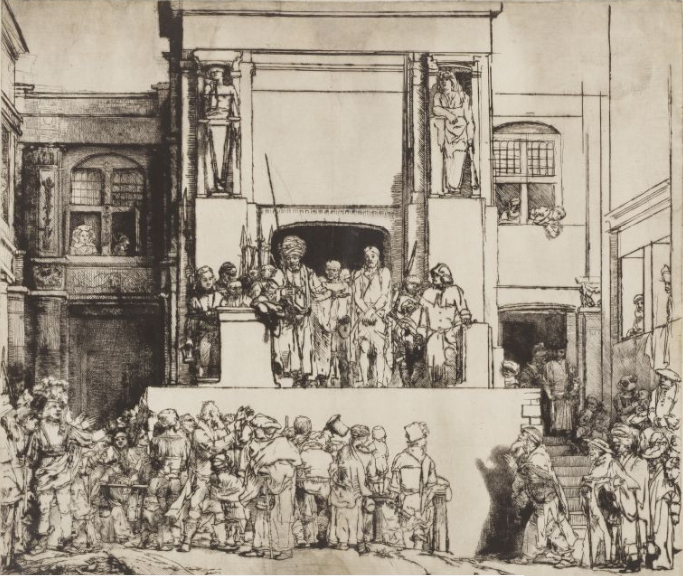
Ecce Homo


Hans Hausser von Ach  (1576-1612) 
Ecce Homo
c 1603
Pen and ink (brown) on paper (light buff)
26.0 cm x 34.0 cm
The Courtauld Gallery, London


Rembrandt van Rijn  (1606 - 1669) 
Christ Presented to the People (Ecce Homo)
c 1655
Drypoint, printed in black ink on cream-colored Asiatic wove paper
38.4 x 45.1 cm
The Frick Collection, New York


Christ is presented to the people who clamour for his crucifixion. 

It was Pilate and the Romans who ironically referred to Christ as "King"

"Pilate tried to release him; but the Jews cried out, “If you release him, you are not a Friend of Caesar. Everyone who makes himself a king opposes Caesar.” 
13 When Pilate heard these words he brought Jesus out and seated him on the judge’s bench in the place called Stone Pavement, in Hebrew, Gabbatha
14 It was preparation day for Passover, and it was about noon. And he said to the Jews, “Behold, your king!” 
15 They cried out, “Take him away, take him away! Crucify him!” Pilate said to them, “Shall I crucify your king?” The chief priests answered, “We have no king but Caesar.” 
16 Then he handed him over to them to be crucified"
(John 19: 12 - 16)
In the New Testament, Christ is referred to as "King of the Jews" by the Magi, Pilate and the Roman soldiers. He is mocked by the Romans. 

On the Cross they affixed the plaque "INRI"  - IESVS·NAZARENVS·REX·IVDÆORVM (Iesus Nazarenus, Rex Iudaeorum)

In Quas Primas (1925), in instituting  the Feast of Christ the King (now called "the Solemnity of Our Lord Jesus Christ, King of the Universe")  Pope Pius XI wrote:
"[T]his power and dignity of Our Lord [as King] is rightly indicated by Cyril of Alexandria. "Christ," he says, "has dominion over all creatures, a dominion not seized by violence nor usurped, but his by essence and by nature."[In huc. x.] 
 His kingship is founded upon the ineffable hypostatic union. From this it follows not only that Christ is to be adored by angels and men, but that to him as man angels and men are subject, and must recognize his empire; by reason of the hypostatic union Christ has power over all creatures.  
But a thought that must give us even greater joy and consolation is this that Christ is our King by acquired, as well as by natural right, for he is our Redeemer.  
Would that they who forget what they have cost their Savior might recall the words:
"You were not redeemed with corruptible things, but with the precious blood of Christ, as of a lamb unspotted and undefiled."[I Pet. i, 18-19
We are no longer our own property, for Christ has purchased us "with a great price"[1 Cor. vi, 20];  our very bodies are the "members of Christ."[I Cor. vi, 15] ... 
This kingdom is spiritual and is concerned with spiritual things.  ...  
On many occasions, when the Jews and even the Apostles wrongly supposed that the Messiah would restore the liberties and the kingdom of Israel, he repelled and denied such a suggestion. When the populace thronged around him in admiration and would have acclaimed him King, he shrank from the honour and sought safety in flight. Before the Roman magistrate he declared that his kingdom was not of this world.  
The gospels present this kingdom as one which men prepare to enter by penance, and cannot actually enter except by faith and by baptism, which, though an external rite, signifies and produces an interior regeneration. This kingdom is opposed to none other than to that of Satan and to the power of darkness.  
It demands of its subjects a spirit of detachment from riches and earthly things, and a spirit of gentleness. They must hunger and thirst after justice, and more than this, they must deny themselves and carry the cross."

Wednesday, November 19, 2014

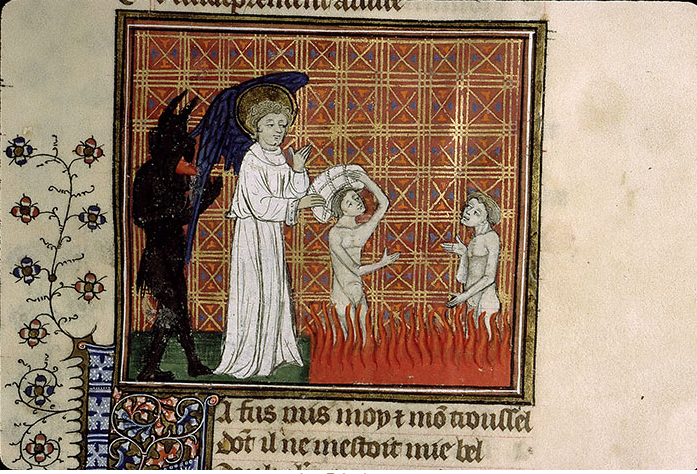
Guillaume de Digulleville


The Soul of the Pilgrim in the Flames of Purgatory
Miniature from Guillaume de Digulleville Pèlerinage de l'âme
14th century
Bibl. Sainte-Geneviève - ms. 1130, f. 110
Paris


Le Pèlerinage de l'Âme is a fourteenth-century poem written in Old French by Guillaume de Deguileville  (1295 - before 1358)

Guillaume de Deguileville  was a French  Cistercian 

He entered the Cistercian abbey of Chaalis in 1316, at the age of twenty-one.

He  was over 60 years old when writing the Âme. The cloistered monk had not left the monastery grounds for 40 years or more

Le Pèlerinage de l'Âme was one of three long poems which he wrote on the theme of man as a traveller, a pilgrim on the road to the Spiritual Jerusalem: Le Pèlerinage de la vie humaine (1330-31); Le Pèlerinage de l'Âme (1355-58); and Le Pèlerinage de Jésus Christ (1358)

All come to the same conclusion: to reach the Celestial Jerusalem, one must experience Death

The setting is a dream but the theme is the same: How does mortal Man save his Immortal Soul

Deguileville was followed by Chemin de vaillance by Jean de Courcy and Chemin de paradis by  Jean Germain, 

In these works the interest lies not not only in the destination itself but the voyage, the means of getting there

The interior journey

Of Purgatory Pope Benedict XVI wrote in Spe Salvi:

"For the great majority of people—we may suppose—there remains in the depths of their being an ultimate interior openness to truth, to love, to God.  
In the concrete choices of life, however, it is covered over by ever new compromises with evil—much filth covers purity, but the thirst for purity remains and it still constantly re-emerges from all that is base and remains present in the soul.  
What happens to such individuals when they appear before the Judge?  
Will all the impurity they have amassed through life suddenly cease to matter? What else might occur?  
Saint Paul, in his First Letter to the Corinthians, gives us an idea of the differing impact of God's judgement according to each person's particular circumstances. He does this using images which in some way try to express the invisible, without it being possible for us to conceptualize these images—simply because we can neither see into the world beyond death nor do we have any experience of it. 
Paul begins by saying that Christian life is built upon a common foundation: Jesus Christ. This foundation endures. If we have stood firm on this foundation and built our life upon it, we know that it cannot be taken away from us even in death.  
Then Paul continues: 
“Now if any one builds on the foundation with gold, silver, precious stones, wood, hay, straw—each man's work will become manifest; for the Day will disclose it, because it will be revealed with fire, and the fire will test what sort of work each one has done. If the work which any man has built on the foundation survives, he will receive a reward. If any man's work is burned up, he will suffer loss, though he himself will be saved, but only as through fire” (1 Cor 3:12-15). 
In this text, it is in any case evident that our salvation can take different forms, that some of what is built may be burned down, that in order to be saved we personally have to pass through “fire” so as to become fully open to receiving God and able to take our place at the table of the eternal marriage-feast."

Tuesday, November 04, 2014

Blessed Paul - alone and exposed


In 1902, Giorgio Montini, the father of Blessed Pope Paul VI, constructed the monument to the Redeemer (above) on the top of Monte  Guglielmo near Brescia

The future Pope was only five years old when the monument was consecrated on 24 August 1902

The monument was restored and despite its age, the weather and its very exposed position it still stands, lonely and against the hostile elements

Every year in July there is a pilgrimage from Brescia to the monument

The statue to the now beatified Pope Paul VI stands beside his father`s monument (above). 

"In his humility the grandeur of Blessed Paul VI shines forth: before the advent of a secularized and hostile society, he could hold fast, with farsightedness and wisdom – and at times alone – to the helm of the barque of Peter, while never losing his joy and his trust in the Lord."

Papa Montini died in 1978. In his Audiences of that year you can detect that he knew the end was coming but he was not afraid. Unfortunately the addresses are only in French, Spanish  and Italian on the Vatican website


His last homily was on 29th June 1978 on the fifteenth anniversary of his election as Pope, on the Feast of Saints Peter and Paul. It reads like a farewell address. 

He said he was in the sunset of his life and wanted to review what he had done over the last fifteen years and give an accounting of his Pontificate

He said he considered himself the last and most unworthy successor of St Peter but on the threshold of death he felt some comfort 
"by the consciousness of having tirelessly repeated in front of the Church and the world, "You are the Christ, the Son of the living God" ( Mt. . 16, 16); we, like Paul, we feel we can say, "I have fought the good fight, I have finished the race, I have kept the faith" (2 Tim. 4: 7)."
He said that he had two accomplishments: the Protection of the Faith; and the Defence of Human Life

As regards the latter, he cited Gaudium et Spes 51: 
"God is the  Lord of life and has entrusted to men the noble mission of safeguarding life!"
In this connection he said that in absolute fidelity to the teachings of the Council he had made the defence of human life in all its forms the central theme of his Pontificate

Of Humanae Vitae ,  he again repeated that the transmission of human life is a most serious role in which married people collaborate freely and responsibly with God the Creator.

He also stressed that the document had become even more urgent and relevant due to the wounds inflicted by State laws on the sanctity of the indissoluble marriage bond and the inviolability of human life from conception

The defence of human life is inextricably linked to Christian marriage: 
"Hence the repeated statements of the doctrine of the Catholic Church on the painful realities and very painful effects of divorce and abortion, which are contained in our ordinary magisterium and in particular acts of the competent Congregation. We have them expressed, moved only by the supreme responsibility of the teacher and of the universal shepherd, and for the good of mankind!"
In the popular mind, Humanae Vitae is about contraception. It is not. It is an encyclical on Christian marriage and the defence of human life in all its forms

At the heart of Humanae Vitae is the following statement:
"[Married] love is above all fully human, a compound of sense and spirit. It is not, then, merely a question of natural instinct or emotional drive. It is also, and above all, an act of the free will, whose trust is such that it is meant not only to survive the joys and sorrows of daily life, but also to grow, so that husband and wife become in a way one heart and one soul, and together attain their human fulfillment. 
It is a love which is total—that very special form of personal friendship in which husband and wife generously share everything, allowing no unreasonable exceptions and not thinking solely of their own convenience. Whoever really loves his partner loves not only for what he receives, but loves that partner for the partner's own sake, content to be able to enrich the other with the gift of himself. 
Married love is also faithful and exclusive of all other, and this until death.  
This is how husband and wife understood it on the day on which, fully aware of what they were doing, they freely vowed themselves to one another in marriage. Though this fidelity of husband and wife sometimes presents difficulties, no one has the right to assert that it is impossible; it is, on the contrary, always honourable and meritorious. The example of countless married couples proves not only that fidelity is in accord with the nature of marriage, but also that it is the source of profound and enduring happiness."

Sunday, November 02, 2014

All Saints


Antonio Boselli (c 1496-1536)
Cristo e la gloria di Ognissanti
Christ and the Glory of All the Saints
1514
Oil on panel
140 cm x 210 cm
Basilica di S. Maria Maggiore, Bergamo, Italy

In June 1449, the city Council of Bergamo entrusted the Basilica of S. Maria Maggiore in Bergamo Alto to the Congregazione della Misericordia Maggiore (The Congregation of Greater Mercy), a charitable foundation begun in 1265 and still very much in existence today

At the end of the fifteenth century, the foundation founded a College of Music with a Cappella Musica in the Basilica (Donizetti was a pupil)

Amongst  the works of art the Congregation commissioned was this work by Boselli in 1514 It still is in the Basilica

In the top centre, Christ is  seated in a mandorla surrounded by the Madonna and a host of angels and saints

With one hand he blesses. In the other he holds a book

There are thirty six saints who are depicted

On the right  among the saints depicted are: St. John the Baptist, St. Peter, St. Stephen, St. Ambrose, St. Augustine, and  St. Mark 

In the centre below Christ  are: Moses, Abraham, St. Gregory the Great and St. Jerome. 

On the left include: St. Catherine of Alexandria, St. Joseph, St. Vincent, St. Mary Magdalene, St. Alexander, San Bernardino, Blessed Guala (Dominican from Bergamo), and S. Proiettizio (a deacon martyr from Bergamo)


"The Solemnity of All Saints, which we celebrate today, invites us to raise our gaze to Heaven and to meditate on the fullness of the divine life which awaits us. “We are God's children now; it does not yet appear what we shall be” (1 Jn 3:2): with these words the Apostle John assures us of the reality of our profound relation to God, as too, of the certainty of our destiny. 
Like beloved children, therefore, we also receive the grace to support the trials of this earthly existence — the hunger and the thirst for justice, the misunderstandings, the persecutions (cf. Mt 5:3-11) — and, at the same time, we inherit what is promised in the Gospel Beatitudes: “promises resplendent with the new image of the world and of man inaugurated by Jesus” (Benedict XVI, Jesus of Nazareth, Milan 2007, p. 72). 
The holiness, imprinted in us by Christ himself, is the goal of Christian life"

Saturday, November 01, 2014

Blessed are those who mourn...


Pierre Antoine Augustin Vafflard (1777–1837)
Study for "Young and His Daughter"
c 1804
Oil on paper, laid down on canvas
27.3 x 20.6 cm
The Metropolitan Museum, New York


Edward Young (1683-1765) was an English Protestant clergyman and writer

At the height of his career and success in the Anglican Church, he married. But happiness did not last. 

His stepdaughter, her husband and finally his wife all died between 1736 and 1740.

The comparison with Job in the Old Testament is unmistakable

His major and most popular work was a nine part poem in blank verse entitled   The Complaint, or Night Thoughts on Life, Death, and Immortality (1742-45)

It consists of a number of dialogues with Lorenzo, a dissipated youth, and meditates on the deaths of Lucia, Narcissa and Philander, whom, according to most interpretations, are loosely based on Young's wife, his stepdaughter and her husband. 

In 1736 Young was traveling through France with his family when his stepdaughter, Elizabeth Temple, died at Lyons. 

Forbidden to inter her remains in the city’s Catholic cemetery because of their religion, he was obliged to seek out the Protestant burial ground in the middle of the night and bury her. This is the subject of the painting. 

It was a very popular work in the French Revolution

The Third Canto entitled Narcissa narrates the macabre story of what happened in Lyon

"And on a foreign shore, where strangers wept! 
155
Strangers to thee, and, more surprising still,
Strangers to kindness, wept; their eyes let fall
Inhuman tears; strange tears, that trickled down
From marble hearts! obdurate tenderness!
A tenderness that call'd them more severe, 
160
In spite of Nature's soft persuasion steel'd.
While Nature melted, Superstition raved:
That mourn'd the dead; and this denied a grave.
Their sighs incensed; sighs foreign to the will!
Their will, the tiger-suck'd, out-raged the storm. 
165
For, O the cursed ungodliness of zeal!
While sinful flesh relented, spirit nursed
In blind Infallibility's embrace,
The sainted spirit petrified the breast;
Denied the charity of dust to spread 
170
O'er dust! a charity their dogs enjoy.
What could I do? what succour, what resource?
With pious sacrilege a grave I stole;
With impious piety that grave I wrong'd;
Short in my duty; coward in my grief! 
175
More like her murderer than friend, I crept
With soft-suspended step, and, muffled deep
In midnight darkness, whisper'd my last sigh.
I whisper'd what should echo through their realms;
Nor writ her name, whose tomb should pierce the skies. 
180
Presumptuous fear! how durst I dread her foes,
While Nature's loudest dictates I obey'd?
(Pardon necessity, blest shade!) Of grief
And indignation rival bursts I pour'd;
Half execration mingled with my prayer; 
185
Kindled at man, while I his God adored;
Sore grudged the savage land her sacred dust;
Stamp'd the cursed soil; and with humanity
(Denied Narcissa) wish'd them all a grave."

The German Bishops' Conference issued a decree in 2012 warning those who opted out of paying the country's "church tax" that they would no longer be entitled to the sacraments, to a religious burial or to play any part in parish life.