Pages

Thursday, June 05, 2014

Wolsey`s Angels


Benedetto da Rovezzano (1474-1554)
Bronze candle-bearing angels
"The Wolsey Angels"
C. 1524-9
Victoria and Albert Museum, London

The Victoria and Albert Museum in London is trying to raise £ 5 million to buy and keep together a set of 4 bronze angels called "The Wolsey Angels"

They were commissioned by Cardinal Wolsey as ornaments for his tomb

Wolsey (1473– 29 November 1530) statesman and Henry VIII's Lord Chancellor fell out of favour in 1530 and died shortly thereafter

His disgrace and downfall came because he could not secure a Papal divorce for his master

The angels never did adorn his tomb. 

He has no memorial and his efforts at securing eternal fame and remembrance were set at naught.

The bronze angels were then seized by Henry VIII for his tomb

The king`s own tomb was never completed and the angels were dispersed

Benedetto da Rovezzano was one of the greatest sculptors of his age

Most of his great remaining works can now only be seen in Tuscany and Rome

His sculptures are exquisite and his works were highly prized and in demand in his day

Tomb decoration seems to have been a lucrative source for commissions for Benedetto among the elite of his day in that perpetual and elusive desire for immortality after death

Often the commissioner was at the height of his power and on the way down such as his work for the tomb of Pier Soderini

St. Thomas More was also a servant and Lord Chancellor of King Henry VIII

But although he was the king's good servant, he was  God's better servant.  He was the king's good servant because he was God's better.

Bronze angels did not adorn his tomb either. His body and tomb were hidden

But he was a witness to the belief that all earthly power is ultimately from God, that his Kingdom is our first and lasting concern and that obedience to his laws is more important than any other obligation or loyalty.

By his death he earned the martyr`s crown, the reward of the Kingdom  and our undying admiration and remembrance.

The trial of St Thomas More for treason took place in Westminster Hall on July 1, 1535

Angels have decorated the ceiling of the Hall. They still do

Four hundred and seventy five years after the Trial, a German born Pope stood in the same Hall to deliver a lecture to the British Parliament. He said:
"As I speak to you in this historic setting, I think of the countless men and women down the centuries who have played their part in the momentous events that have taken place within these walls and have shaped the lives of many generations of Britons, and others besides. 
In particular, I recall the figure of Saint Thomas More, the great English scholar and statesman, who is admired by believers and non-believers alike for the integrity with which he followed his conscience, even at the cost of displeasing the sovereign whose “good servant” he was, because he chose to serve God first. 
The dilemma which faced More in those difficult times, the perennial question of the relationship between what is owed to Caesar and what is owed to God, allows me the opportunity to reflect with you briefly on the proper place of religious belief within the political process. ... 
And yet the fundamental questions at stake in Thomas More’s trial continue to present themselves in ever-changing terms as new social conditions emerge. 
Each generation, as it seeks to advance the common good, must ask anew: what are the requirements that governments may reasonably impose upon citizens, and how far do they extend? By appeal to what authority can moral dilemmas be resolved? 
These questions take us directly to the ethical foundations of civil discourse. If the moral principles underpinning the democratic process are themselves determined by nothing more solid than social consensus, then the fragility of the process becomes all too evident - herein lies the real challenge for democracy.... 
The angels looking down on us from the magnificent ceiling of this ancient Hall remind us of the long tradition from which British Parliamentary democracy has evolved. 
They remind us that God is constantly watching over us to guide and protect us. 
And they summon us to acknowledge the vital contribution that religious belief has made and can continue to make to the life of the nation."

Tuesday, June 03, 2014

Saint Boniface, the English Apostle


Sir Edward Coley Burne-Jones (1833‑1898)
St Boniface
From Cartoons for a Window at the Church of St Mary the Virgin, Speldhurst, Kent
1875
Charcoal and graphite on paper
731 x 400 mm
Tate Britain, London


This is one of the six British saints in a window in the Church of St Mary the Virgin, Speldhurst, Kent. 

The designs were executed in 1875 and the glass was in place the following year by  The Morris Company

The other saints were: St Alban, St Aidan, St Helena, St Oswold and St Walburga. 

It is conscious medievalism, Gothic. It attempts  to summon up a time that probably never existed. But it was and is an inspiration


Christian Wilhelm Ernst Dietrich 1712 -1774
Saint Boniface Felling the Sacred Oak
Oil on canvas
74.4 x 104.5 cm
Scottish National Gallery, Edinburgh

The Christian saint and martyr Boniface was born Winifrid and probably in England

He was Archbishop of Mainz, 744-54. 

He was a Scholar and missionary among Germanic peoples, the "Apostle of the German peoples"

Martyred, he was buried at Fulda and is still widely venerated in Germany and Holland

According to the 8th century Vita Bonifatii auctore Willibaldi, Boniface felled the Donar Oak, ("Jupiter's oak" ) near the present-day town of Fritzlar in northern Hesse. 

Boniface started to chop the oak down, when suddenly a great wind blew the ancient oak over. 

When the pagan god did not strike him down, the people were amazed and converted to Christianity. 

He built a chapel dedicated to Saint Peter from its wood at the site. The chapel was the beginning of the monastery in Fritzlar.

Fritzlar was the birthplace of the German Empire which lasted from the 10th century until the Napoleonic Wars in the 19th century

In 1741 Dietrich was appointed court painter to Augustus III at Dresden (He was also King of Poland and Grand Duke of Lithuania from 1734 until 1763, as well as Elector of Saxony in the Holy Roman Empire from 1733 until 1763)

Thus the painting depicting the Apostle of Germany has  more political meaning than religious


Edward Dujardin (1817 - 1889)
Saint Boniface kneeling on the ground being blessed by Saint Willibrord
1853
Pen lithograph
113 millimetres  x 83 millimetres
The British Museum, London

Edward Du Jardin was a Belgian painter based in Antwerp. He painted many religious works including Stations of the Cross

A political Flemish extremist, this work of his is religious and bears no political message

Pope Leo XIII in his Encyclical Officio Sanctissimo (22nd December 1887) extolled St Boniface when talking about the Church in Bavaria thus:
" But he to whom beyond others praise is certainly due, in that he nourished and cherished the faith in Bavaria, is St. Boniface, the Archbishop of Mayence, who also is celebrated in an undying and most trustworthy account as the father of Christian Germany, its Apostle and Martyr.  
He fulfilled the office of legate to the Roman Pontiffs Gregory the Second and Third, and Zachary, in whose favour he stood high, and in their name and by their authority he divided the country of Bavaria into dioceses, and thus, having constituted a regular hierarchy, handed on the faith which had been planted there to future generations.  
St. Gregory II, writing to Boniface himself, says: 
"The field of the Lord, which was lying waste, and had grown unfruitful through infidelity with the thorns of thistles, being tilled by the ploughshare of Thy doctrine, has received the seed of the word and brought forth an abundant harvest of faithfulness." (Ep. xiii. ad Bonifacium - cfr. Labbeurm Collect. Conc. v., viii.) 
From that time the religion of the Bavarians remained safe and sure through all changes in civil affairs, although in course of time very sharply tried. For indeed there ensued those broils and contentions of the empire against the priesthood which were so bitter, enduring, and destructive; in these, however, there was more to rejoice than to sadden the Church in Bavaria."
These were words written just after Bismarck`s Kulturkampf

More recently on the 1250th anniversary of the Martyrdom of St Boniface, Saint John Paul II recalled in 2004 that
"St Boniface was discouraged neither by the difficulties caused by the obstacles he encountered nor by failure and defeats.  
He bequeathed to others for their guidance his own experience of life:   
"Let us stand firm in the fight on the day of the Lord, for days of affliction and misery are here.... We are not dogs that cannot speak, nor silent observers, nor mercenaries fleeing from wolves! Instead, we are hard-working Pastors who watch over Christ's flock, who proclaim God's will to people whether important or ordinary, rich or poor... in season and out of season" (Boniface to Cuthbert, Archbishop of Canterbury, in the year 747)."

Sunday, June 01, 2014

Marcellinus and Peter, Martyrs


Master of the San Lucchese Altarpiece (Florentine, active mid 14th century)
A Martyrdom
c 1350
Tempera and gold on panel
18.6 x 29.6 cm
Scottish National Gallery, The Mound, Edinburgh


Marcellinus was a priest, and Peter an exorcist, both of the clergy of Rome

They perished in the persecution of Domitian

Their tomb was in the now named Catacombs of Saints Marcellino and Pietro Ad Duas Lauros (at the two laurel trees)

The Catacombs have just recently reopened after restoration

Here is a 12th century representation of the deaths of the martyrs by a Ad Duas Lauros, an illuminator


Fr. Ruffilus
The executions of Saints Marcellinus and Peter, Martyrs of Rome
Passio ss. Marcellini et Petri BHL 5231. >Incipit passio sanctorum martyrum Marcellini et Petri< Benignitas saluatoris nostri martyrum perseuerantia 
From The Lives of the Saints
12th century
Parchment
Cod. Bodmer 127, f 73
Fondation Martin Bodmer, Cologny


Their cult was among those martyrs whose cult was promoted by Passionary of Weissenau (366-84)

The pope composed an epigram or epitaph for their tomb in the Catacombs
"XXII. 
Marcelline tuos pariter Petre nosse triumphos 
percussor retulit Damaso mihi, cum puer essem. 
haec sibi carnificem rabidum mandata dedisse: 
sentibus in mediis vestra ut tunc colla secaret, 
ne tumulum vestrum quisquam cognoscere posset; 
vos alacres vestris manibus mundasse sepulcra 
candidule, occulto postquam iacuisse sub antro, 
postea commonitam vestra pietate Lucillam, 
hic placuisse magis sanctissima condere membra"

Of the martyrs Pope Benedict XVI once said of St Stephen protomartyr and the martyrs in general 16th December 2009
"The witness borne by Stephen, like that of the Christian martyrs, shows our contemporaries, who are often distracted and uncertain, in whom they should place their trust in order to give meaning to their lives. 
The martyr, in fact, is one who dies knowing with certainty that he is loved by God, who puts nothing before love of Christ, knowing that he has chosen the better part. 
The martyr is configured fully to the death of Christ, aware of being a fertile seed of life and of opening up paths of peace and hope in the world"

Thursday, May 29, 2014

Meditating on the Ruins


Anne-Louis Girodet de Roussy-Trioson (1767–1824)
Portrait de Chateaubriand méditant sur les ruines de Rome
Portrait of Chateaubriand Meditating on the Ruins of Rome
c 1809
Oil on canvas and panel
140 x 116 cm
Musée d'Histoire de Saint-Malo, Saint-Malo


The young Victor Hugo once rather surprisingly declared: "Je veux être Chateaubriand ou rien."

François -Auguste- René, vicomte de Chateaubriand 1768 - 1848  is one of the great figures of the French Romantic movement

He fled France during the French Revolution and took refuge in London

The major turning point in Chateaubriand's life was his conversion back to the Catholic faith of his childhood around 1798.

In 1802, he published Génie du christianisme ("The Genius of Christianity"), a spirited apology for the Catholic Christian faith which contributed to the post-revolutionary religious revival in France.

The work  was a major inspiration for the Romantic movement

The book`s subtitle was The spirit and beauty of the Christian religion

During the Terror his mother and other members of his family were imprisoned and died there.  He received the news while in London

Here is the text from the original preface of the first  edition of 1802, which appears to have been omitted in later editions


He describes how his mother died in  1798, with a prayer on her lips for the conversion of her son. 
"She charged one of my sisters ... to recall me to a sense  of that religion in which I had been educated, and my  sister made known to me her wish. When the letter reached me beyond the water, my sister also had departed this life, having succumbed under the effects of her imprisonment. Those two voices coming up from the grave, and that death which had now become the interpreter of death, struck me with peculiar force. I became a Christian. I did not yield to any great supernatural light : my conviction came from the heart. I wept, and I believed." 
Anne-Louis Girodet 1767 –  1824 was a French Romantic painter and pupil of David

Girodet early on broke free from his mentor Jacques-Louis David’s influence and veered away from the rigid Neoclassical style then prevalent in France. 

He produced creative and moving renditions of episodes in contemporary literature, notably the myths of Ossian, admired by Napoleon, and the writings of Chateaubriand. 

In The Burial of Atala, Girodet painted a scene from  Chateaubriand’s tragic love story, Atala, or the Loves of Two Savages in the Desert. The work was  also called The Funeral of Atala and is in the Musée Girodet, Montargis. Another version is in the Louvre

In the portrait Chateaubriand is shown in meditation in the Colosseum in Rome where he was the secretary to the French Mission to the Holy See

At this time Rome was in the hands of the forces of Napoleon and Chateaubriand was still to publish Les Martyrs (1809) and Itinéraire de Paris à Jérusalem (1811).

In 1810 Napoleon inspected the portrait. He did not like it. He said: « Il a l’air d’un conspirateur qui descend dans la cheminée. »

Wednesday, May 28, 2014

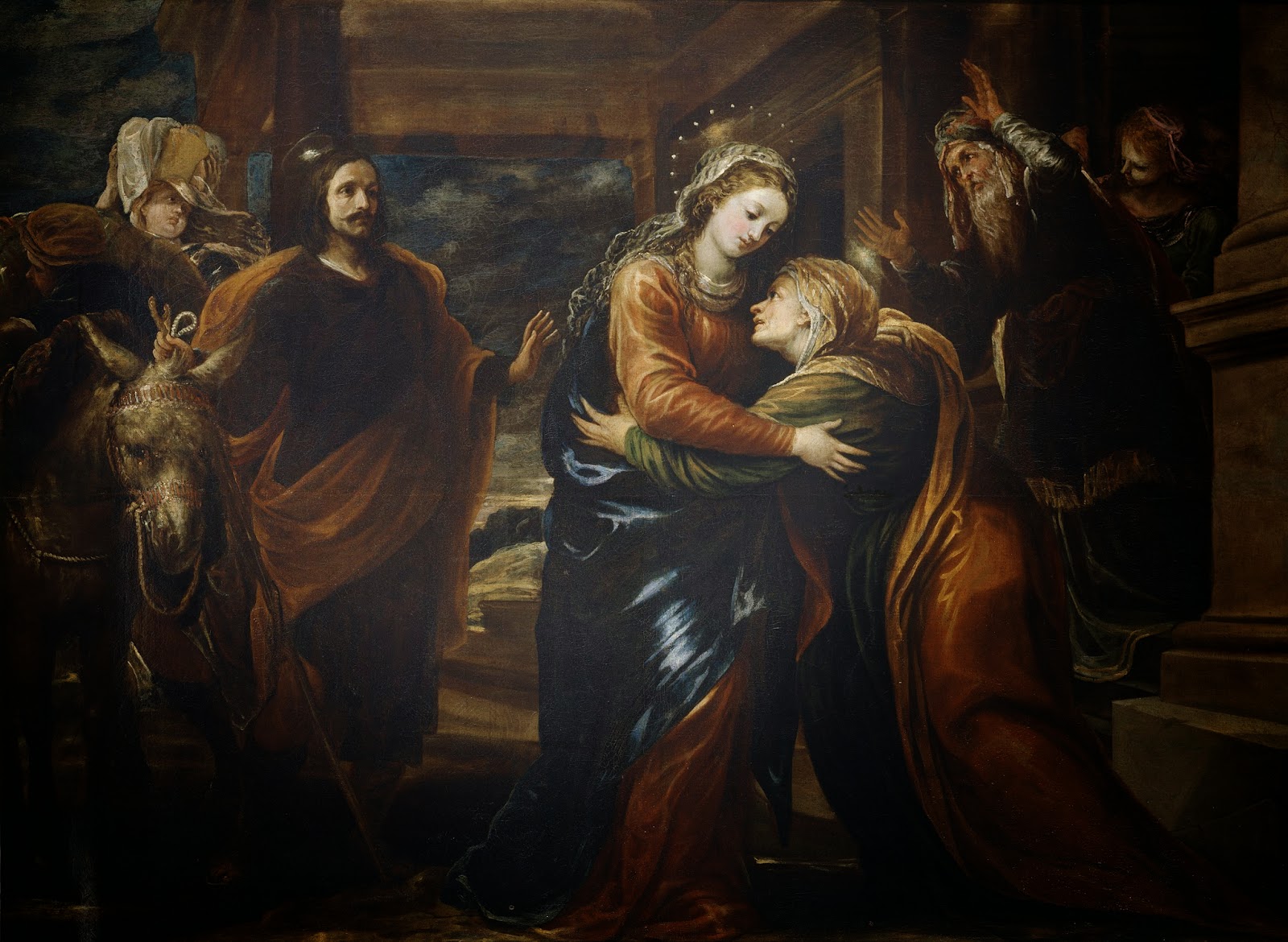
In Ain Karim


Francesco Rizi  1614 - 1685
La Visitación/ The Visitation
1663
Oil on canvas
206 cm x 290 cm
Museo Nacional del Prado, Madrid

Rizi was an artist of the Spanish High Baroque from a family of artists who originally hailed from Bologna in Italy

In his day he was one of the most influential Spanish artists of his time especially of religious works. He was painter to the Spanish court and the Cathedral of Toledo

He was also an accomplished stage designer

In this work we see richness of colour, movement, theatricality, flamboyance  and drama
"In those days Mary arose and went with haste into the hill country, to a city of Judah, and she entered the house of Zechariah and greeted Elizabeth. And when Elizabeth heard the greeting of Mary, the babe leaped in her womb; and Elizabeth was filled with the Holy Spirit and she exclaimed with a loud cry, 'Blessed are you among women, and blessed is the fruit of your womb!"' (Lk 1:39-42)
Mary bears within her the Word made flesh.  

She goes to help her elderly cousin who is about to give birth. In Mary we recognize the figure of the Church which, through her works of mercy and charity, brings Christ to the world.

Of this event Saint John Paul II wrote in Redemptoris Mater
"Immediately after the narration of the Annunciation, the Evangelist Luke guides us in the footsteps of the Virgin of Nazareth towards "a city of Judah" (Lk. 1:39). According to scholars this city would be the modern Ain Karim, situated in the mountains, not far from Jerusalem.  
Mary arrived there "in haste," to visit Elizabeth her kinswoman. The reason for her visit is also to be found in the fact that at the Annunciation Gabriel had made special mention of Elizabeth, who in her old age had conceived a son by her husband Zechariah, through the power of God: "your kins woman Elizabeth in her old age has also conceived a Son; and this is the sixth month with her who was called barren. For with God nothing will be impossible" (Lk. 1:36-37).  
The divine messenger had spoken of what had been accomplished in Elizabeth in order to answer Mary's question. "How shall this be, since I have no husband?" (Lk. 1:34) It is to come to pass precisely through the "power of the Most High," just as it happened in the case of Elizabeth, and even more so. 
Moved by charity, therefore, Mary goes to the house of her kinswoman."

Tuesday, May 27, 2014

The Ascension of Christ


George Tinworth (1843-1916)
1898-99
Terracotta
Each panel: 3.2m  x 1.24m
Chapel at St Thomas` Hospital, Westminster Bridge Road, London SE1

Tinworth worked for the Doulton factory at Lambeth in South London  from 1867 until his death

He also lectured at the Art School in Lambeth

Many of his pieces were shown at the Royal Academy where they were admired by many including John Ruskin

The mystery of the Ascension of Christ is not easy to depict in art

Early medieval manuscripts depict apostles looking into the air. All the rest of us see is a pair of feet as below


The Master of the Dresden Prayerbook (active: about 1465 - about 1515)
f. 228r: The Ascension of Christ (Ascension Day)
From The Breviary of Queen Isabella of Castile
Add MS 17738, f. 228r
c. 1485
Parchment
230 x 160 mm
The British Library, London

In his scholarly and erudite way Pope Benedict XVI threw light on the Mystery of the Ascension of Christ in a homily at Cassino on Sunday, 24 May 2009 which perhaps shows that Tinsley had a greater understanding of this great Mystery than many others have had

""You shall receive power when the Holy Spirit has come upon you; and you shall be my witnesses in Jerusalem and in all Judea and Samaria and to the end of the earth" (Acts 1: 8). 
With these words, Jesus took his leave of the Apostles, as we heard in the First Reading. Immediately afterwards the sacred Author adds that "as they were looking on, he was lifted up, and a cloud took him out of their sight" (Acts 1: 9). 
This is the mystery of the Ascension that we are celebrating today. 
But what do the Bible and the Liturgy wish to tell us by saying that Jesus "was lifted up"? 
We cannot understand the meaning of these words from a single text or from a single book of the New Testament but rather by listening attentively to the whole of Sacred Scripture. In fact the verb "to lift up" was originally used in the Old Testament and refers to royal enthronement. 
Thus Christ's Ascension means in the first place the enthronement of the Crucified and Risen Son of Man, the manifestation of God's kingship over the world. 
However, there is an even deeper meaning that is not immediately perceptible. 
In the passage from the Acts of the Apostles it is said first that Jesus was "lifted up" (v. 9) and then it says "taken up" (v. 11). 
The event is not described as a journey to on high but rather as an action of the power of God who introduces Jesus into the space of closeness to the Divine. The presence of the cloud that "took him out of their sight" (v. 9), recalls a very ancient image of Old Testament theology and integrates the account of the Ascension into the history of God with Israel, from the cloud of Sinai and above the tent of the Covenant in the desert, to the luminous cloud on the mountain of the Transfiguration.  
To present the Lord wrapped in clouds calls to mind once and for all the same mystery expressed in the symbolism of the phrase, "seated at the right hand of God". 
In Christ ascended into Heaven, the human being has entered into intimacy with God in a new and unheard-of way; man henceforth finds room in God for ever. "Heaven": this word Heaven does not indicate a place above the stars but something far more daring and sublime: it indicates Christ himself, the divine Person who welcomes humanity fully and for ever, the One in whom God and man are inseparably united for ever. 
Man's being in God, this is Heaven. And we draw close to Heaven, indeed, we enter Heaven to the extent that we draw close to Jesus and enter into communion with him. 
For this reason today's Solemnity of the Ascension invites us to be in profound communion with the dead and Risen Jesus, invisibly present in the life of each one of us."

Sunday, May 25, 2014

Ecclesiae anglicanae trophaea


Ecclesiae anglicanae trophaea was printed at Rome by Bartolomeo Grassi in 1584. 


The thirty six  engravings in the book (by Giovanni Battista Cavalieri) were reproduced from murals painted originally by Nicolò Circignano on the walls of the chapel of the Venerable English College in Rome

The early plates depict the early years of the establishment of Christianity in England

However the later plates depict the deaths of English Catholics at the hands of the Tudor monarchs. It is the Catholic response to Foxe’s Actes and Monuments (known as Foxe's Book of Martyrs)

The frescoes on the walls of the chapel were commissioned and paid for by George Gilbert SJ 1559 - 1583

The engravings wre paid for by Father William Good SJ (1527–1586)

The Title plate has the title inscribed in a cartouche flanked by two figures adopting elegant contrapposto, two angels supporting the cartouche from below and holding a garland 

There is the motto 'Sancti per fidem vicerunt regna'

There is a Dedication: 'R. Dno Thomae Tretero Canonico S. Mariae Transtyberim in Urbe, et Ser. Regis Poloniae secretario Dno suo Colendiss. Dicavit. Anno Dni M.D.LXXXIII'

The Iconography is Jesuit

We also see the depiction of the commission given by Saint Pope Gregory the Great to Saint Augustine of Canterbury

Bede in his Ecclesiastical History of the English Nation, Book I, chapter 23 describes the main scene depicted:
"IN the year of our Lord 582, Maurice, the fifty ­fourth from Augustus, ascended the throne, and reigned twenty ­one years. 
In the tenth year of his reign, Gregory, a man renowned for learning and behaviour, was promoted to the apostolical see of Rome, and presided over it thirteen years, six months and ten days. 
He, being moved by Divine inspiration, in the fourteenth year of the same emperor, and about the one hundred and fiftieth after the coming of the English into Britain, sent the servant of God, Augustine, and with him several other monks, who feared the Lord, to preach the word of God to the English nation. they having, in obedience to the pope's commands, undertaken that work, were, on their journey, seized with a sudden fear, and began to think of returning home, rather than proceed to a barbarous, fierce, and unbelieving nation, to whose very language they were strangers; and this they unanimously agreed was the safest course. 
In short, they sent back. Augustine, who had been appointed to be consecrated bishop in case they were received by the English, that he might, by humble entreaty, obtain of the Holy Gregory, that they should not be compelled to undertake so dangerous, toilsome, and uncertain a journey. 
The pope, in reply, sent them a hortatory epistle, persuading them to proceed in the work of the Divine word, and rely on the assistance of the Almighty. The purport of which letter was as follows­ 
"Gregory, the servant of the servants of God, to the servants of our Lord. Forasmuch as it had been better not to begin a good work, than to think of desisting from that which has been begun, it behooves you, my beloved sons, to fulfil the good work, which, by the help of our Lord, you have undertaken. 
Let not, therefore, the toil of the journey, nor the tongues of evil speaking men, after you; but with all possible earnestness and zeal perform that which, by God's direction, you have undertaken; being assured, that much labour is followed by an eternal reward. 
When Augustine, your chief, returns, whom we also constitute your abbot, humbly obey him in all things; knowing, that whatsoever you shall do by his direction, will, in all respects, be available to your souls. Almighty God protect you with his grace, and grant that I may, in the heavenly country, see the fruits of your labour. 
In Inasmuch as, though I cannot labour with you, I shall partake in the joy of the reward, because I am willing to labour. God keep you in safety, my most beloved sons. 
Dated the 23rd of July, in the fourteenth year of the reign of our pious and most august lord, Mauritius Tiberius, the thirteenth year after the consulship of our said lord. The fourteenth indiction."

Saturday, May 24, 2014

Saint Augustine of Canterbury


Frank Brangwyn 1867–1956
St Augustine at Ebbsfleet
c 1920
Tempera on canvas
228 x 405.5 cm
Christ's Hospital Foundation, Horsham

Ebbsfleet is a hamlet near Ramsgate, Kent

In AD 597 St Augustine of Canterbury (died 26 May 604) with a party of forty landed here in a mission to re-establish Christianity within England

In other parts of Britain there were already movements towards  conversion and reconversion. St Columba was already at lona in AD 563

According to legend,  the first meeting between King Ethelbert and the monk Augustine took place under an oak tree in 597 AD. Nearby was a stream, known as St Augustine's Well, where it is said that Augustine baptized his first convert and on Whit Sunday of 597 AD King Ethelbert himself was converted.

In 1884 St Augustine's Cross  was erected to commemorate the landing of St Augustine in AD 597 at Ebbsfleet. 

Bede in his Ecclesiastical History of the English Nation, Book I, chapter 25 describes the scene in this way
"AUGUSTINE, thus strengthened by the confirmation of the blessed Father Gregory, returned to the work of the word of God, with the servants of Christ, and arrived in Britain. 
The powerful Ethelbert was at that time king of Kent; he had extended his dominions as far as the great river Humber, by which the Southern Saxons are divided from the Northern. 
On the east of Kent is the large Isle of Thanet containing according to the English way of reckoning, 600 families, divided from the other land by the river Wantsum, which is about three furlongs over, and fordable only in two places, for both ends of it run into the sea. 
In this island landed the servant of our Lord, Augustine, and his companions, being, as is reported, nearly forty men. 
They had, by order of the blessed Pope Gregory, taken interpreters of the nation of the Franks, and sending to Ethelbert, signified that they were come from Rome, and brought a joyful message, which most undoubtedly assured to all that took advantage of it everlasting joys in heaven and a kingdom that would never end with the living and true God. 
The king having heard this, ordered them to stay in that island where they had landed, and that they should be furnished with all necessaries, till he should consider what to do with them. 
For he had before heard of the Christian religion, having a Christian wife of the royal family of the Franks, called Bertha; whom he had received from her parents, upon condition that she should be permitted to practice her religion with the Bishop Luidhard, who was sent with her to preserve her faith. 
Some days after, the king came into the island, and sitting in the open air, ordered Augustine and his companions to be brought into his presence. 
For he had taken precaution that they should not come to him in any house, lest, according to an ancient superstition, if they practiced any magical arts, they might impose upon him, and so get the better of him. 
But they came furnished with Divine, not with magic virtue, bearing a silver cross for their banner, and the image of our Lord and Saviour painted on a board; and singing the litany, they offered up their prayers to the Lord for the eternal salvation both of themselves and of those to whom they were come. 
When he had sat down, pursuant to the king's commands, and preached to him and his attendants there present, the word of life, the king answered thus: ­ 
"Your words and promises are very fair, but as they are new to us, and of uncertain import, I cannot approve of them so far as to forsake that which I have so long followed with the whole English nation. But because you are come from far into my kingdom, and, as I conceive, are desirous to impart to us those things which you believe to be true, and most beneficial, we will not molest you, but give you favourable entertainment, and take care to supply you with your necessary sustenance; nor do we forbid you to preach and gain as many as you can to your religion."
Accordingly he permitted them to reside in the city of Canterbury, which was the metropolis of all his dominions, and, pursuant to his promise, besides allowing them sustenance, did not refuse them liberty to preach. 
It is reported that, as they drew near to the city, after their manner, with the holy cross, and the image of our sovereign Lord and King, Jesus Christ, they, in concert, sung this litany: 
"We beseech Thee, O Lord, in all Thy mercy, that thy anger and wrath be turned away from this city, and from the holy house, because we have sinned. Hallelujah." "

Friday, May 23, 2014

13th March 1622


Andrea Sacchi 1599 - 1661
Inside the Church of S Maria in Vallicella durung the celebrations of 13th March 1622
Oil on canvas
98 x 74 cm
Pinacoteca, Musei Vaticani, Citta del Vaticano

Sacchi was one of the leading classical painters in Rome in the second quarter of the seventeenth century.

He was the exponent of  'High Baroque Classicism'.

Contrary to the views of his great rival  Pietro da Cortona on the question of whether history paintings should have few figures or many this work upholds Sacchi`s view that few is better


On 12th March 1622, Pope Gregory XV canonised the five great saints of the Catholic Reform: Saints Philip Neri, Ignatius Loyola, Teresa of Avila, Francis Xavier, and Isidore of Seville

The next day there was a procession from St Peters to each of the churches of the five new saints

This painting celebrates the arrival of the procession at the Chiesa Nova where the great banner depicting the saint was deposited

The great standard shows St Philip Neri in the act of praying to Madonna and Child

It was made of red silk and commissioned by the regents of the Grand Duchy of Tuscany: Maria Maddalena of Austria and Christina of Lorraine. It is still in existence. The saint was of course born in Florence

Exuberant theatricality is the keynote of this work

Do we see Sacchi himself on the bottom right gazing out at us over the centuries ?

Tuesday, May 20, 2014

Benedicta Tu in Mulieribus


Eric Gill (1882‑1940)
Jesus Meets His Mother 1915
Marble sculpture with gold
5`8" x 5`8"
Westminster Cathedral, London


Eric Gill (1882‑1940)
Jesus Meets His Mother 1917
Wood engraving on paper
54 x 54 mm
Tate Britain, London

Christ bearing his cross on the Way to Calvary with the Virgin Mary, his mother, kneeling before him
The words from the Hail  Mary are inscribed in a prominent place

 “Mary is blessed among women, for with the dignity of virginity she has enjoyed the grace to be parent to a son who is God” (St Bede the Venerable , Hom I, 3: CCL 122, 16).

Monday, May 19, 2014

Pearls of Wisdom


Urs Graf ca. 1485–1529/30 
Title page of Margarita Philosophica
From Gregorius Reisch 1467 - 1525, Margarita Philosophica
Printer: Johann Schott ( 1477–1548)
March-April 1504
22.5 x 15.5 x 7 cm
Printed: Straßburg
Bayerische Staatsbibliothek, Munich


Urs Graf ca. 1485–1529/30 
Typus Geometrie
From Gregorius Reisch 1467 - 1525, Margarita Philosophica
Printer: Johann Schott ( 1477–1548)
March-April 1504
22.5 x 15.5 x 7 cm
Printed: Straßburg
Bayerische Staatsbibliothek, Munich


Urs Graf ca. 1485–1529/30 
Typus Musice
From Gregorius Reisch 1467 - 1525, Margarita Philosophica
Printer: Johann Schott ( 1477–1548)
March-April 1504
22.5 x 15.5 x 7 cm
Printed: Straßburg
Bayerische Staatsbibliothek, Munich


Urs Graf ca. 1485–1529/30 
The Eye: Animae Sensititivae
From Gregorius Reisch 1467 - 1525, Margarita Philosophica
Printer: Johann Schott ( 1477–1548)
March-April 1504
22.5 x 15.5 x 7 cm
Printed: Straßburg
Bayerische Staatsbibliothek, Munich


Gregor Reisch (Gregorius Reisch) 1467 - 1525 graduated from the University of Freiburg in 1489

He joined the Carthusian Order in 1496

He became the prior of the Carthusian monastery in Johannisberg in 1501


It was completed in 1496

It is the first philosophical encyclopedia of science in the German language. It  was in the 16th century the key textbook in the German universities and used up until well into the 17th century.It was repeatedly reissued and in 1599  it was also translated into Italian.

A humanist he brought Realism into Scholasticism

He corresponded with Erasmus and other great figures of the Humanist Renaissance

See Andrew Cunningham and Sachiko Kusukawa, Natural philosophy epitomised: a translation of books 8-11 of Gregor Reisch's philosophical pearl (1503) (Ashgate 2010)

As regards the title page,  in the centre of the picture is a crowned 3-headed winged female figure holding an open book and sceptre. 

At the top of the page above the central female figure  is Theology. 

Theology is represented by the four great Doctors of the Church: St Augustine and St Gregory, and then on the right, St Jerome and St Ambrose 

Surrounding the central female figure are seven female figures representing the seven liberal arts holding emblems relating to those arts. 

In the bottom corners of the picture are two eminent philosophers - Aristotle (Natural Philosophy) and Seneca (Moral Philosophy). 

The names of the sciences are written in the circle, that is, Grammar, Dialectic, Rhetoric, Arithmetic, Music, Geometry, Astronomy, Principles of Natural Philosophy, Origin of Natural Objects, Psychology, Logic and Ethics.


The illustrator Urs Graf ca. 1485–1529/30  also merits mention

A Swiss swashbuckler of great talent and versatility

Larger than life

A veritable Cellini. Although probably Graf did what was only in Cellini`s imagination

When he was not in prison or being a mercenary or out on the town, Graf produced a remarkable corpus of work

He was the first artist to produce an etching (on an iron plate). Along with Durer he was also the first artist to use pen and ink for completed drawings

It has been said of him that 
"He treated the world in which he lived with irreverent wit, tking as his themes topics such as the life of the mercenaries, erotic experience (especially  prostitutes) and the vain aspiration to pious virtue. Next to the vanity and folly of human, he also depicted  mythological and religious themes, using different means of expression."

Graf also produced the illustrations for another work of Rausch: an edition of Statua ordinis cartusiensis (1510) 

This compendium of the statues of the Carthusian Order (edited by Rausch) was printed at the expense of the Carthusian monastery of St. John the Baptist in Freiburg im Breisgau

Saturday, May 17, 2014

A Roman Lime Kiln


Sébastien Bourdon 1616-1671
A Roman Lime Kiln 
1637
Oil on canvas
172,5 x 245,5 cm
Bayerische Staatsgemäldesammlungen, Munich

Sébastien Bourdon, a French Baroque artist, was Court painter to Queen Christina of Sweden

This is his early masterpiece »A Roman Lime Kiln«, probably painted around 1637 in Rome. 

Lime is being burnt and sold close to famous monuments in Rome. 

Bourdon was himself open to the inspiration of other great painters, and his style evolved throughout his career. Among those he copied were: The Bamboccianti, Giovanni Benedetto Castiglione, Anthony van Dyck and Nicolas Poussin 

He himself was one of The Bamboccianti in 1638, he had to flee Rome to escape denunciation by the Inquisition for his Protestant faith

For some reason the picture put me in mind of what Rome might be like this Summer

Perhaps I have been reading too much of Father Z: here, here , here , and here

Friday, May 16, 2014

A Painter of the Sacred Heart


Séraphine Louis, called  Séraphine de Senlis, 1864 - 1942
Fleurs dans un panier
c 1910
Gouache on paper
29 x 20 cm
Musée d'art et d'archéologie, Senlis


I have written on a number of occasions before about the great French artist Séraphine Louis (1864-1942)(also known as Séraphine de Senlis)

She was one of a group of painters whom the art critic Wilhelm Uhde (Ulrich Tukur) "discovered" in the 1920s

They were Séraphine Louis,  Louis Vivin, André Bauchant, and Camille Bombois

All self taught. Their work was described as  “Primitive” and “naïf ”  (but not naive)

In 1928 Uhde described them as Les peintres du Cœur sacré, ("The Painters of the Sacred Heart") which was the title of he exhibition of their works in Paris which he organised for them to great acclaim and sent them into great public knowledge and esteem

Sadly she became ill in later years and was committed to a psychiatric hospital in Villers-sous-Erquery

She died on 11th December 1942 aged 78 years and was buried in a paupers communal grave in Clermont

She was one of the 40,000 psychatric patients who died of starvation in the harsh and barbaric conditions of French psychiatric hospitals in  Vichy France ("L'extermination douce") during the occupation by the Germans

Her medical record states that she died of starvation and was reduced to cutting grass at night to eat as well as eating rubbish

This was a common occurrence in French psychiatric hospitals at this time, following on the ideas of the French Eugenicists including the Nobel Prize Winner, Alexis Carrel

The painting above  is an early work of Louis, before her discovery by Uhde

On the back of the painting there is a text: Consécration des familles chrétiennes au coeur de Jésus

She appears to have had a strong Christian faith although not perhaps mainstream

On 29th June 1943, Pope Pius XII published his Encyclical Mystici Corporis Christi which includes this passage written in the middle of the Second World War, only six months after the death of Louis and while the killing was still going on:
"94. For as the Apostle with good reason admonishes us: "Those that seem the more feeble members of the Body are more necessary; and those that we think the less honourable members of the Body, we surround with more abundant honour."[ I Cor., XII, 22-23]  
Conscious of the obligations of Our high office We deem it necessary to reiterate this grave statement today, when to Our profound grief We see at times the deformed, the insane, and those suffering from hereditary disease deprived of their lives, as though they were a useless burden to Society; and this procedure is hailed by some as a manifestation of human progress, and as something that is entirely in accordance with the common good.  
Yet who that is possessed of sound judgment does not recognize that this not only violates the natural and the divine law [Decree of the Holy Office, 2 Dec. 1940: A.A.S., 1940, p. 553] written in the heart of every man, but that it outrages the noblest instincts of humanity?  
The blood of these unfortunate victims who are all the dearer to our Redeemer because they are deserving of greater pity, "cries to God from the earth."[Gen., IV, 10.]"