Sir James Thornhill 1676 - 1734
Paul and Silas in prison (Acts, XVI, 29)
Before 1715
Black and red chalk, with brown-grey wash, touched with pen and black ink and heightened with white, on buff paper
375 millimetres x 250 millimetres
The British Museum, London
Published by Philips Galle 1537 - 1612
After Jan van der Straet 1523 - 1605
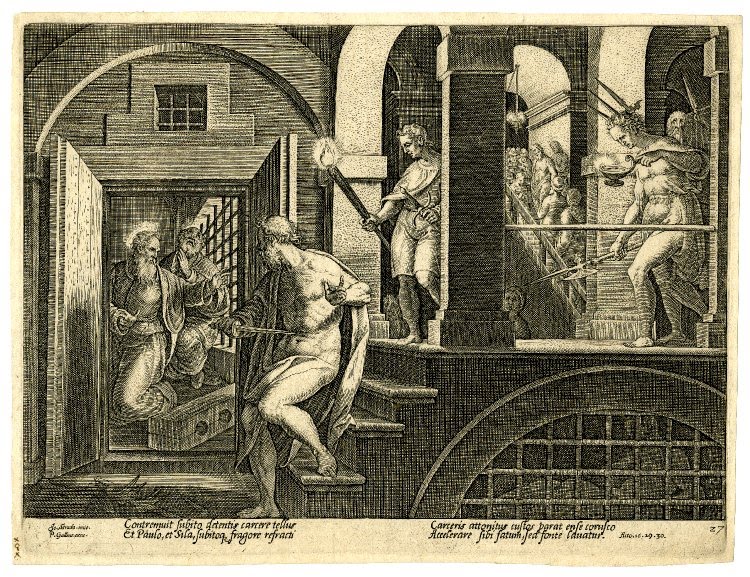
The Conversion of the Warder (Acts 16:25-31)
1582
Engraving
200 millimetres x 263 millimetres
The British Museum, London
Philippi in Macedonia was the first place in Europe where St Paul preached the Gospel.
The mission was successful until St Paul exorcised a slave girl in the market. Infuriated by his cure which rendered the girl worthless as a fortune teller, her owners brought Paul and Silas to the authorities.
After being beaten, they were imprisoned and put in the stocks.
During the night there was an earthquake. Acts chapter 16, verses 26 -36 describes what happened next:
"26 Suddenly there was such a violent earthquake that the foundations of the prison were shaken. At once all the prison doors flew open, and everyone’s chains came loose. 27 The jailer woke up, and when he saw the prison doors open, he drew his sword and was about to kill himself because he thought the prisoners had escaped.
28 But Paul shouted, “Don’t harm yourself! We are all here!”
29 The jailer called for lights, rushed in and fell trembling before Paul and Silas.
30 He then brought them out and asked, “Sirs, what must I do to be saved?”
31 They replied, “Believe in the Lord Jesus, and you will be saved—you and your household.”
32 Then they spoke the word of the Lord to him and to all the others in his house.
33 At that hour of the night the jailer took them and washed their wounds; then immediately he and all his household were baptized. 34 The jailer brought them into his house and set a meal before them; he was filled with joy because he had come to believe in God—he and his whole household.
35 When it was daylight, the magistrates sent their officers to the jailer with the order: “Release those men.”
36 The jailer told Paul, “The magistrates have ordered that you and Silas be released. Now you can leave. Go in peace.” "
It is a dramatic scene but rarely depicted in painting. From total despair, the warder becomes filled with joy "because he had come to believe in God—he and his whole household."
However it was depicted on the cupola of St Paul`s Cathedral in London and Thornhill`s drawing is a study for the work.
The question of the jailer "What must I do to be saved?” is a profound one. A more important one than life or death. It concerns eternal life or eternal damnation.
The question had been asked before.
In Judaea, Jesus was asked by the rich man “Teacher, what good thing must I do to get eternal life?”, His answers to the rich man distressed the disciples causing them to ask Jesus “Who then can be saved?” Peter complained, “We have left everything to follow you! What then will there be for us?”
The incident is narrated in Matthew 19: 16 - 30:
"16 Just then a man came up to Jesus and asked, “Teacher, what good thing must I do to get eternal life?”
17 “Why do you ask me about what is good?” Jesus replied. “There is only One who is good. If you want to enter life, keep the commandments.”
18 “Which ones?” he inquired.
Jesus replied, “‘You shall not murder, you shall not commit adultery, you shall not steal, you shall not give false testimony, 19 honour your father and mother,’ and ‘love your neighbour as yourself.’”
20 “All these I have kept,” the young man said. “What do I still lack?”
21 Jesus answered, “If you want to be perfect, go, sell your possessions and give to the poor, and you will have treasure in heaven. Then come, follow me.”
22 When the young man heard this, he went away sad, because he had great wealth.
23 Then Jesus said to his disciples, “Truly I tell you, it is hard for someone who is rich to enter the kingdom of heaven. 24 Again I tell you, it is easier for a camel to go through the eye of a needle than for someone who is rich to enter the kingdom of God.”
25 When the disciples heard this, they were greatly astonished and asked, “Who then can be saved?”
26 Jesus looked at them and said, “With man this is impossible, but with God all things are possible.”
27 Peter answered him, “We have left everything to follow you! What then will there be for us?”
28 Jesus said to them, “Truly I tell you, at the renewal of all things, when the Son of Man sits on his glorious throne, you who have followed me will also sit on twelve thrones, judging the twelve tribes of Israel.
29 And everyone who has left houses or brothers or sisters or father or mother or wife or children or fields for my sake will receive a hundred times as much and will inherit eternal life.
30 But many who are first will be last, and many who are last will be first"
The first part of the story is depicted below. It is in The Riverside Church, New York. It is perhaps ironic that it is one of three paintings by
Heinrich Hofmann which John D. Rockefeller, Jr. donated to
The Riverside Church
Heinrich Hofmann 1824-1911
Christ and the Young Rich Man (1889)
The Riverside Church, New York
In this Titianesque painting by Watts, Watts interprets the story thus, focusing on the rich man who interrogated Jesus.
George Frederic Watts 1817-1904
`For he had great possessions' 1894
Oil on canvas
support: 1397 x 584 mm
The Tate, London
The caption for the painting in the Tate describes the painting as being antagonist towards Greed. That is a rather simplistic view and one ideologically committed towards a particular viewpoint.
Watts was more subtle. He knew the passage in the Bible well. He would have known that this passage in Scripture was not an easy one to interpret.
Watts focuses on the rich young man. The dialogue with Christ reveals the complex character and motivation of this man.
The question asked by the rich young man is quite significant: “Teacher, what good thing must I do to get eternal life?”
Christ is rather surprised at how the question is phrased and what lies behind the question. The young man is used to getting what he wants. He pays for it. He is a high achiever. It is to be another checkmark to achieve in the to-do list in the Checklist of Life. One gets the impression that perhaps humility is not his strongest virtue.
In effect he is saying tell me what to do, I`ll do it and everything will be all right. I will be all right.
Did Jesus suspect that he was being set up for a trap by the Pharisees ?
Christ asked him directly: “Why do you ask me about what is good?”. The man does not answer this question. He avoids the question entirely. He asks another question instead: What commandments must he keep to enter into eternal life ? He does not wish to reveal why he wishes to do good, or to be good.
Instead he answers Christ`s question with a question. This is not entering dialogue to arrive at Truth. There must be a reason for the questions of this rich young man. Something is not right about this conversation. There is no communication or dialogue. The two men are on different planes.
Christ tells him that he must keep the Commandments and in particular, five of the Decalogue given to Moses and another one: ‘love your neighbour as yourself.’ The last is not in the Decalogue but enunciated in Deuteronomy and Leviticus and advocated by Rabbi Hillel.
The list given by Christ is rather surprising. There are some notable omissions. What happened to the first three commandments of the Decalogue ? What about the remaining two with the prohibitions against covetousness (although it could be argues that this is contained in the commandment` to love thy neighbour`)
Rather astonishingly the young man replied that he had kept all of the commandments listed. He wanted to know what he still needed to do.
This answer is to say the least disingenuous. He probably could say without hesitation that he that had not murdered, committed adultery, or perjury. He probably had and did honour his parents. But could anyone give such a quick and unequivocal answer to the question “Do you love your neighbour as yourself?”
Either he is lying or lacking in self-knowledge or has a strange view of what is meant by “love” or the content of the Second Great Commandment.
Jesus has sized this man up. The man does not speak honestly. Jesus sees his weakest point: the man`s self-centredness and the man`s great attachment to material and earthly possessions. The man is his possessions and his possessions are him. What will he give up or sacrifice to be part of the Kingdom of God ? Will he radically reform his life? Will he give up all his possessions?
For the young man, Christ`s condition for him to be part of his followers –to give up all his possessions – is too great a sacrifice. He leaves saddened.
What is said after he leaves is significant.
First there is Christ`s celebrated saying about the camel and the eye of the needle. Second, is the Apostles` reaction. They are dismayed.
Peter asks “Who then can be saved ?” and , “We have left everything to follow you! What then will there be for us?”
At this stage of his mission, Christ`s explanations to the Apostles must have been enigmatic and capable of being taken in a number of ways,
If we had been in the rich man`s position, would our attitude have been different from his or the Apostles ? Perhaps Watts` painting depicts someone not so very different from us. There is a deeper message being conveyed in the Scripture passage and in the paintings by Watts and by Hofmann than simply a criticism of wealth and avarice.
It was the quest of the rich young man who appealed to Jesus to tell him the “Secret” of Eternal Life. The Pope described this quest thus:
“The question of how man can attain the heights, becoming completely himself and completely like God, has always engaged mankind.”
He went on to describe the quest of St Augustine.
Attributed to José de Ribera (“Lo Spagnoletto” or “El Españoleto”) (1591- 1652)
San Agustín en oración/ St Augustine in prayer
Oil on canvas
203 x 150 cm
Museo Nacional del Prado, Madrid
He described the attempts by St Augustine and the neo-Platonists:
“[The question of how man can attain the heights] was passionately disputed by the Platonic philosophers of the third and fourth centuries. For them, the central issue was finding the means of purification which could free man from the heavy load weighing him down and thus enable him to ascend to the heights of his true being, to the heights of divinity.
Saint Augustine, in his search for the right path, long sought guidance from those philosophies.
But in the end he had to acknowledge that their answers were insufficient, their methods would not truly lead him to God. To those philosophers he said: recognize that human power and all these purifications are not enough to bring man in truth to the heights of the divine, to his own heights.
And he added that he should have despaired of himself and human existence had he not found the One who accomplishes what we of ourselves cannot accomplish; the One who raises us up to the heights of God in spite of our wretchedness: Jesus Christ who from God came down to us and, in his crucified love, takes us by the hand and lifts us on high.”
The questions of the Warder and of the Rich Young Man are of course the problem. They are not the correct questions to ask.
It is not a matter of “I” and what “I” have to do. There is the small problem of God and the grace of God.
It is not a matter of doing. There is the issue of disposition, the total conversion of the person, the unity of the person with Christ.
Then there is the matter of Love, the virtue of Charity. Is “salvation” simply a matter of doing an act which will lead to a personal advantage and the act is for the purpose of gaining that advantage. ?
Are acts totally irrelevant or are they a necessary step in the progress towards a state of holiness ?
Is it a relationship and process between the person and the Trinity involving Christ, the Holy Spirit and the Father, a lifetime commitment and not a one-off event or a series of separate discrete events ?
How does one reach the heights of holiness according to Pope Benedict ? How is one “saved” ? He sketches out his answer in the last catechesis on the
Lives of the Saints on 13 April 2011:
“Holiness is the fullness of the Christian life, a life in Christ; it consists in our being united to Christ, making our own his thoughts and actions, and conforming our lives to his.
As such, it is chiefly the work of the Holy Spirit who is poured forth into our hearts through Baptism, making us sharers in the paschal mystery and enabling us to live a new life in union with the Risen Christ.
Christian holiness is nothing other than the virtue of charity lived to its fullest. In the pursuit of holiness, we allow the seed of God's life and love to be cultivated by hearing his word and putting it into practice, by prayer and the celebration of the sacraments, by sacrifice and service of our brothers and sisters.
The lives of the saints encourage us along this great path leading to the fullness of eternal life. By their prayers, and the grace of the Holy Spirit, may each of us live fully our Christian vocation and thus become a stone in that great mosaic of holiness which God is creating in history, so that the glory shining on the face of Christ may be seen in all its splendour.”
The Pope goes on to consider each point. It is a remarkable Confession of Faith and Doctrine retailed with reference to key themes in Pope Benedict`s teaching: everything is Christocentric, the importance of the Passion, Crucifixion and Resurrection, the works of the Holy Spirit, the life and works of St Augustine, the importance and true meaning of Christian Love, the importance of the Mass and the Sacraments, the Second Great Commandment and sacrifice and service to one`s neighbour, and the importance of the Lives of the Saints and their veneration, and the Communion of Saints.
In an interesting passage of his talk, he explains for us in simple language some signposts and the celebrated teaching of St Augustine, which has been so misinterpreted and misused in the past:
“[P]erhaps we should say things in a still simpler way.
What is the most essential?
Essential is that no Sunday be left without an encounter with the Risen Christ in the Eucharist -- this is not a burden but light for the whole week.
Never to begin or end a day without at least a brief contact with God.
And, in the journey of our life, to follow "road signs" that God has communicated to us in the Decalogue read with Christ, which is simply the definition of charity in specific situations.
I think this is the true simplicity and grandeur of the life of holiness: the encounter with the Risen One on Sunday; contact with God at the beginning and end of the day; in decisions, to follow the "road signs" that God has communicated to us, which are simply forms of charity. From whence charity for God and for our neighbor is made the distinctive sign of the true disciple of Christ. (Lumen Gentium , 42).
This is true simplicity, grandeur and profundity of the Christian life, of being saints.
This is why St. Augustine, commenting on the fourth chapter of the First Letter of St. John can affirm an astonishing thing: "Dilige et fac quod vis" (Love and do what you will).
And he continued:
"If you are silent, be silent out of love; if you speak, speak out of love; if you correct, correct out of love; if you forgive, forgive out of love, may the root of love be in you, because from this root nothing can come that is not good" (7, 8: PL 35).
He who lets himself be led by love, who lives charity fully is led by God, because God is love. This is what this great saying means: "Dilige et fac quod vis" (Love and do as you will)."