San Alberto de Sicilia (Saint Albert of Sicily or Trapani)
1670
Oil on canvas
116 cm x 78 cm
Museo Nacional del Prado, Madrid
On the death of his patron Crescenzi, Pereda was expelled from the Royal Spanish Court in 1635
He was then commissioned by religious institutions to carry out religious works or with a religious theme
This work was commissioned for the Carmelite (Discalced) convent of Saint Damasus in Madrid
The Carmelite saint was born in Trapani, about 1240, and became provincial of his order in the island of Sicily
He died in Messina in 1307
He is considered another patron and protector, or ‘Father of the Order’
There is often confusion between Saint Albert of Jerusalem – lawgiver of Carmel – and Saint Albert of Trapani – father of the Order – which has caused the latter to be somewhat overlooked.
Albert of Trapani was distinguished for his preaching, working miracles, and his desire for prayer.
In particular among the many with a devotion to this saint were Saint Teresa of Jesus (Teresa of Avila) and Saint Mary Magdalene de' Pazzi.
St Teresa asked the Dominican Diego de Yanguas to write a biography of St Albert which he did. She asked Don Teutonio to publish it. She wanted this book published with her Way of Perfection
The books were published in February 1583, four months after Teresa’s death.
He is shown picured holding a lily, a book, or a crucifix
In the late 15th century Sforza Book of Hours we see him preaching and healing
Giovan Pietro Birago (active 1471 - 1513)
St Albert of Trapani
c. 1490-1494
Add MS 34294, f 204
The Sforza Book of Hours Volume 3
Miniature
130 x 95 mm
The British Library, London
In the Cathedral at Prato in Italy, his image occupies a prominent place on the end wall of the choir beside the cycle on the lives of Sts Stephen and John the Baptist. The work is also by Fra Filippo Lippi and was composed while he was in safety in Prato from 1452-1465
Lippi was also a Carmelite
Fra Filippo di Tommaso Lippi (1406 circa – 1469)
St Alberto of Trapani
1452-65
Fresco
The Duomo, Prato
Here we see him depicted in a print by the Carmelite artist Giovanni Maria da Brescia (active 1500 - 1512).
He is second from the right at the bottom pictured along side other saints
Giovanni Maria da Brescia (active 1500 - 1512)
The Virgin and Christ Child appearing to five saints, from left John the Baptist, Angelus, Cyril of Constantinople, Albert of Sicily and St Jerome
1512
Engraving
331 x 231 mm
The British Museum, London
And in this print from about 1615 by Hieronymus Wierix we see the adoration of God and veneration of Mary by St Albert and his "companion saint", St Angelus, Martyr
Hieronymus Wierix (1553 - 1619)
The Adoration of God and Veneration of the Virgin by Saints Albert of Trapani and Angelus, Martyr
Bartolo di Fredi (also known as Bartolo Battiloro)(1330-1410)
Detail of The Trinity
1396
Tempera on wood panel
Musée des Beaux-Arts, Chambéry
The Gothic and the Renaissance periods were not separate discrete periods or movements
The terms are artificial distinctions used by art historians to impose order on what might otherwise be a series of discrete events and circumstances happening in different places at different times in vastly different circumstances
Artists did not wake up one day and say - enough of the Gothic, on with the Renaissance
Styles existed side by side
Artists trained in one style would learn or discover new techniques and combine these into their own methods
As distinct from the "supply" side, customer demand would favour new fashions or approaches
Certain cities like Siena were slower than others in Tuscany to take on board the new fashions all the rage in Florence. But they did see what was happening and did adapt their existing styles
Here he adheres to the Gothic tradition: the balanced and symmetrical composition, the use of gold, the use of hieratic characters and in his colours. But we also see the search for depth and perspective
The epitome of the "new style" in the depiction of The Trinity can be seen in Masaccio`s celebrated Trinity in Santa Maria Novella in Florence, thus:
Tommaso di Ser Giovanni di Simone (Masaccio) (1401 – 1428)
The Trinity
1425
Fresco
667 cm × 317 cm
Santa Maria Novella, Florence
But in looking at these great depictions one is apt to overlook the substance of what is being conveyed
There is a commonality but there are also differences
Both artists in their different ways are conveying different aspects of that mystery which we call the Trinity, the central mystery of the Christian faith and of Christian life.
In di Fredi we see an image of the Father who bears a resemblance to the Son
On either side of the Son and beneath Him are the closest members of his human family: Mary and St John
Mary is, apart from Christ, is the only human who ever got the closest to God without being God: the Immaculate Conception; the Annunciation; the Nativity; the Marriage Feast at Cana; the Crucifixion; the Resurrection; the Ascension; the Pentecost; the Assumption
Mary, in both pictures, is the one who faces the viewer and presents the viewer to her Son and thence the Trinity
John is the one to whom Christ entrusted his mother
"22 And I have given them the glory you gave me, so that they may be one, as we are one,
23 I in them and you in me, that they may be brought to perfection as one, that the world may know that you sent me, and that you loved them even as you loved me.
24 Father, they are your gift to me. I wish that where I am they also may be with me, that they may see my glory that you gave me, because you loved me before the foundation of the world.
25 Righteous Father, the world also does not know you, but I know you, and they know that you sent me.
26 I made known to them your name and I will make it known, that the love with which you loved me may be in them and I in them."
The same elements are present in Masaccio
In this version of The Trinity in the London Rothschild Hours or the Hours of Joanna I of Castile we see a version of The Trinity in its barest essentials
The workshop of the Maximilian Master (active at Ghent c 1475 - 85)
The Trinity
From The Suffrage of the Saints in the London Rothschild Hours or the Hours of Joanna I of Castile
Parchment
235 x 165 mm
f.210v, Add MS 35313
The British Library, London
The Trinity is One: one God in three persons
Each of them is God whole and entire but wholly distinct from one another
Each is in relation to each other
God is eternal blessedness, undying life, unfading light as well as Love: Father, Son and Holy Spirit.
Each divine person performs the common work according to his unique personal property.
Thus the Church confesses, following the New Testament, "one God and Father from whom all things are, and one Lord Jesus Christ, through whom all things are, and one Holy Spirit in whom all things are" (Catechism of the Catholic Church, paras 232 - 267)
This Miniature of Pentecost by the great French artist Jean Bourdichon is at the beginning of the Hours of the Holy Spirit.
In the early 1480s, Jean Bourdichon succeeded Jean Fouquet as peintre du roi and valet de chambre. He retained these positions under four successive French kings: Louis XI, Charles VIII, Louis XII, and François I.
This image is probably part of the Book of Hours commissioned for Louis XII (reigned 1498-1515) to celebrate the king’s coronation in 1498.
He employs dramatic close-ups with volumetric half-figures occupying the foreground
The inscription is: "Domine labia mea aperies Et os meum annunciabit laudem tuam." (Thou O Lord wilt open my lips And my mouth shall declare thy praise) (Psalm 51:15)
Mary is at the centre of the work. In the foreground are John and Peter
As to Pentecost we remember the words of Jesus before the Crucifixion as reported in John`s Gospel. He talked about the coming of the Advocate in Chapter 16
12 “I have much more to tell you, but you cannot bear it now.
13 But when he comes, the Spirit of truth, he will guide you to all truth. He will not speak on his own, but he will speak what he hears, and will declare to you the things that are coming.
14 He will glorify me, because he will take from what is mine and declare it to you.
15 Everything that the Father has is mine; for this reason I told you that he will take from what is mine and declare it to you.
16 “A little while and you will no longer see me, and again a little while later and you will see me.”
17 So some of his disciples said to one another, “What does this mean that he is saying to us, ‘A little while and you will not see me, and again a little while and you will see me,’ and ‘Because I am going to the Father’?”
18 So they said, “What is this ‘little while’ [of which he speaks]? We do not know what he means.”
19 Jesus knew that they wanted to ask him, so he said to them, “Are you discussing with one another what I said, ‘A little while and you will not see me, and again a little while and you will see me’?
20 Amen, amen, I say to you, you will weep and mourn, while the world rejoices; you will grieve, but your grief will become joy.
21 When a woman is in labour, she is in anguish because her hour has arrived; but when she has given birth to a child, she no longer remembers the pain because of her joy that a child has been born into the world.
22 So you also are now in anguish. But I will see you again, and your hearts will rejoice, and no one will take your joy away from you.
23 On that day you will not question me about anything. Amen, amen, I say to you, whatever you ask the Father in my name he will give you.
24 Until now you have not asked anything in my name; ask and you will receive, so that your joy may be complete."
Miniature of the Pentecost
From The Augsburg Sacramentary
Harley 2908 f. 69v
2nd or 3rd quarter of the 11th century
Parchment codex
210 x 165 mm
The British Library, London
The sacramentary was made for made for the cathedral church of St. Ulrich and Afra in Augsburg in the 11th century
We know that one of the illuminators of this work was a monk called Ulrich
The rest of his life is known only to God
The Miniatures reflect the important events of the Church`s liturgical life: the Crucifixion, the Nativity and Annunciation to the Shepherds, the Holy Women at the Tomb, the Ascension, Pentecost, and the Assumption
"102. Holy Mother Church is conscious that she must celebrate the saving work of her divine Spouse by devoutly recalling it on certain days throughout the course of the year. Every week, on the day which she has called the Lord's day, she keeps the memory of the Lord's resurrection, which she also celebrates once in the year, together with His blessed passion, in the most solemn festival of Easter.
Within the cycle of a year, moreover, she unfolds the whole mystery of Christ, from the incarnation and birth until the ascension, the day of Pentecost, and the expectation of blessed hope and of the coming of the Lord.
Recalling thus the mysteries of redemption, the Church opens to the faithful the riches of her Lord's powers and merits, so that these are in some way made present for all time, and the faithful are enabled to lay hold upon them and become filled with saving grace."
"5. Through the incarnation of the Word the Redeemer's uniqueness becomes discernible to us already in its redeeming force. In the paschal mystery the Redeemer has made salvation available to all:
“And I, when I am lifted up from the earth, will draw all people to myself” (Jn 12:32).
The gift of Pentecost enabled his apostles and disciples finally to recognize who and what Jesus was as in the fellowship of the Church—the teaching, the breaking of bread, the prayers (Acts 2:42)—they became aware of what Jesus had done for them, what he had taught and commanded. This is precisely the function of the Holy Spirit in Johannine theology (cf. Jn 16:13-15).
6. Hence we as human beings can come to know who the Redeemer is, but only within the community of the Church and through it. Christ cannot be isolated from the Church"
Maître François (active 1462 - 1480)
Miniature of the Pentecost
f. 178v, Egerton 2045
From Hours, Use of Rome
c. 1460 - c. 1470
Parchment codex
45 x 25 mm
The British Library, London
Maître François is the soubriquet of an artist belonging to a workshop of Parisian illuminators whose primary artist is designated as the Master of Jean Rolin
He depicts the attendees of the first Pentecost as clothed in white
In the account of Pentecost and its aftermath in Acts 2we read that the Apostle Peter stood up with the eleven and proclaimed to the crowd. He called on them to repent and be baptised
Then they that received his word were baptised: and the same day there were added to their group about three thousand souls.
From the early days of Western Christianity, Pentecost became one of the days set aside to celebrate Baptism
The term Whit Sunday derives from the custom of the newly baptised wearing white clothing, and from the white vestments worn by the clergy in some jurisdictions
"25. The Acts of the Apostles describes the life of the early Christian community in a way that is fundamental for the Church of all times: ‘They devoted themselves to the apostles’ teaching and fellowship, to the breaking of bread and the prayers’ (Acts 2:42; cf. Rev 1:3). This succinct description, at the end of the account of the feast of Pentecost, when the Holy Spirit opened the mouths of the apostles to preach and brought many of those who heard them to faith, highlights various essential aspects of the Spirit’s ongoing work in the Church. There is already an anticipatory outline of the Church’s teaching and sacramental life, of its spirituality and commitment to charity. All of these began in the apostolic community, and the handing on of this integral way of life in the Spirit is Apostolic Tradition. Lex orandi (the rule of prayer), lex credendi (the rule of belief) and lex vivendi (the rule of life) are all essential aspects of this Tradition. Paul refers to the Tradition into which as an apostle he has been incorporated when he speaks of ‘handing on’ what he himself ‘received’ (1Cor 15:1-11, cf. also 1 Cor 11:23-26)."
To finish here is a rendition of Saint Hildegard of Bingen, O ignis Spiritus Paracliti
O ignis spiritus paracliti, / vita vite omnis creature, / sanctus es vivificando formas
It was in the possession of the founder. Carrara acquired it from a church in the small town of Alzano Lombardo, an ancient mountain town in the Valle Seriana
It came under the rule of Venice
It is a town crammed full of religious art but appears relatively unknown
Like the Venetian and Bergamesque artists of his generation he makes real the entirely different orders of reality, one supernatural, the other earthly
The Holy Spirit is not just a figment of religious imagination but a metaphysically real being who comes to those who earnestly pray
The Holy Spirit acts corporeally. He does not only act subjectively or "spiritually".
The setting is that mysterious Upper Room in Jerusalem: the setting of the Last Supper, the appearance of Christ to the Apostles after the Resurrection and of the first Pentecost
Recently Pope Francis gave a homily in the Upper Room in that Upper Room (Jerusalem) on Monday, 26 May 2014 during his visit to the Holy Land
He said:
"Here, where Jesus shared the Last Supper with the apostles; where, after his resurrection, he appeared in their midst; where the Holy Spirit descended with power upon Mary and the disciples, here the Church was born, and she was born to go forth.
From here she set out, with the broken bread in her hands, the wounds of Christ before her eyes, and the Spirit of love in her heart.
In the Upper Room, the risen Jesus, sent by the Father, bestowed upon the apostles his own Spirit and with his power he sent them forth to renew the face of the earth (cf. Ps 104:30)."
This is a contemporary 16th century Italian villa or palazzo built according to the principles of Classical architecture as rediscovered in the Italian Renaissance
Mary is the centre of the composition as Christ is the centre of the composition in The Last Supper. She stands on a golden pedestal surrounded by the Apostles
The two Apostles who flank her are Saints Peter and St John the Evangelist, the same two who were instructed by Jesus to find the Upper Room and make the preparations for The Last Supper
Rather incongruously is also depicted St Paul - who was of course not there at the first Pentecost
"Celebrating this Eucharist in the Upper Room in Jerusalem, we are united with the Church of every time and place.
United with the Head, we are in communion with Peter and the Apostles and their Successors down the ages.
In union with Mary, the Saints and Martyrs, and all the baptized who have lived in the grace of the Holy Spirit, we cry out: Marana tha! “Come, Lord Jesus!” (Cf. Rev 22:17). Bring us, and all your chosen ones, to the fullness of grace in your eternal Kingdom. Amen."
And is St Paul not the author of one of the kerygma in Acts, one of the fruits of Pentecost ? (1 Corinthians 15) ?
"You know that the Holy Spirit constitutes the soul, the life blood of the Church and of every individual Christian:
He is the Love of God who makes of our hearts his dwelling place and enters into communion with us. The Holy Spirit abides with us always, he is always within us, in our hearts.
The Spirit himself is “the gift of God” par excellence (cf. Jn 4:10), he is a gift of God, and he in turn communicates various spiritual gifts to those who receive him.
The Church identifies seven, a number which symbolically speaks of fullness, completeness; they are those we learn about when we prepare for the Sacrament of Confirmation and which we invoke in the ancient prayer called the “Sequence of the Holy Spirit”.
The gifts of the Holy Spirit are: wisdom, understanding, counsel, fortitude, knowledge, piety and fear of the Lord."
Most of his great remaining works can now only be seen in Tuscany and Rome
His sculptures are exquisite and his works were highly prized and in demand in his day
Tomb decoration seems to have been a lucrative source for commissions for Benedetto among the elite of his day in that perpetual and elusive desire for immortality after death
Often the commissioner was at the height of his power and on the way down such as his work for the tomb of Pier Soderini
St. Thomas More was also a servant and Lord Chancellor of King Henry VIII
But although he was the king's good servant, he was God's better servant. He was the king's good servant because he was God's better.
Bronze angels did not adorn his tomb either. His body and tomb were hidden
But he was a witness to the belief that all earthly power is ultimately from God, that his Kingdom is our first and lasting concern and that obedience to his laws is more important than any other obligation or loyalty.
By his death he earned the martyr`s crown, the reward of the Kingdom and our undying admiration and remembrance.
The trial of St Thomas More for treason took place in Westminster Hall on July 1, 1535
Angels have decorated the ceiling of the Hall. They still do
Four hundred and seventy five years after the Trial, a German born Pope stood in the same Hall to deliver a lecture to the British Parliament. He said:
"As I speak to you in this historic setting, I think of the countless men and women down the centuries who have played their part in the momentous events that have taken place within these walls and have shaped the lives of many generations of Britons, and others besides.
In particular, I recall the figure of Saint Thomas More, the great English scholar and statesman, who is admired by believers and non-believers alike for the integrity with which he followed his conscience, even at the cost of displeasing the sovereign whose “good servant” he was, because he chose to serve God first.
The dilemma which faced More in those difficult times, the perennial question of the relationship between what is owed to Caesar and what is owed to God, allows me the opportunity to reflect with you briefly on the proper place of religious belief within the political process. ...
And yet the fundamental questions at stake in Thomas More’s trial continue to present themselves in ever-changing terms as new social conditions emerge.
Each generation, as it seeks to advance the common good, must ask anew: what are the requirements that governments may reasonably impose upon citizens, and how far do they extend? By appeal to what authority can moral dilemmas be resolved?
These questions take us directly to the ethical foundations of civil discourse. If the moral principles underpinning the democratic process are themselves determined by nothing more solid than social consensus, then the fragility of the process becomes all too evident - herein lies the real challenge for democracy....
The angels looking down on us from the magnificent ceiling of this ancient Hall remind us of the long tradition from which British Parliamentary democracy has evolved.
They remind us that God is constantly watching over us to guide and protect us.
And they summon us to acknowledge the vital contribution that religious belief has made and can continue to make to the life of the nation."
The designs were executed in 1875 and the glass was in place the following year by The Morris Company
The other saints were: St Alban, St Aidan, St Helena, St Oswold and St Walburga.
It is conscious medievalism, Gothic. It attempts to summon up a time that probably never existed. But it was and is an inspiration
Christian Wilhelm Ernst Dietrich 1712 -1774
Saint Boniface Felling the Sacred Oak
Oil on canvas
74.4 x 104.5 cm
Scottish National Gallery, Edinburgh
The Christian saint and martyr Boniface was born Winifrid and probably in England
He was Archbishop of Mainz, 744-54.
He was a Scholar and missionary among Germanic peoples, the "Apostle of the German peoples"
Martyred, he was buried at Fulda and is still widely venerated in Germany and Holland
According to the 8th century Vita Bonifatii auctore Willibaldi, Boniface felled the Donar Oak, ("Jupiter's oak" ) near the present-day town of Fritzlar in northern Hesse.
Boniface started to chop the oak down, when suddenly a great wind blew the ancient oak over.
When the pagan god did not strike him down, the people were amazed and converted to Christianity.
He built a chapel dedicated to Saint Peter from its wood at the site. The chapel was the beginning of the monastery in Fritzlar.
Fritzlar was the birthplace of the German Empire which lasted from the 10th century until the Napoleonic Wars in the 19th century
In 1741 Dietrich was appointed court painter to Augustus III at Dresden (He was also King of Poland and Grand Duke of Lithuania from 1734 until 1763, as well as Elector of Saxony in the Holy Roman Empire from 1733 until 1763)
Thus the painting depicting the Apostle of Germany has more political meaning than religious
Edward Dujardin (1817 - 1889)
Saint Boniface kneeling on the ground being blessed by Saint Willibrord
1853
Pen lithograph
113 millimetres x 83 millimetres
The British Museum, London
Edward Du Jardin was a Belgian painter based in Antwerp. He painted many religious works including Stations of the Cross
A political Flemish extremist, this work of his is religious and bears no political message
Pope Leo XIII in his Encyclical Officio Sanctissimo (22nd December 1887) extolled St Boniface when talking about the Church in Bavaria thus:
" But he to whom beyond others praise is certainly due, in that he nourished and cherished the faith in Bavaria, is St. Boniface, the Archbishop of Mayence, who also is celebrated in an undying and most trustworthy account as the father of Christian Germany, its Apostle and Martyr.
He fulfilled the office of legate to the Roman Pontiffs Gregory the Second and Third, and Zachary, in whose favour he stood high, and in their name and by their authority he divided the country of Bavaria into dioceses, and thus, having constituted a regular hierarchy, handed on the faith which had been planted there to future generations.
St. Gregory II, writing to Boniface himself, says:
"The field of the Lord, which was lying waste, and had grown unfruitful through infidelity with the thorns of thistles, being tilled by the ploughshare of Thy doctrine, has received the seed of the word and brought forth an abundant harvest of faithfulness." (Ep. xiii. ad Bonifacium - cfr. Labbeurm Collect. Conc. v., viii.)
From that time the religion of the Bavarians remained safe and sure through all changes in civil affairs, although in course of time very sharply tried. For indeed there ensued those broils and contentions of the empire against the priesthood which were so bitter, enduring, and destructive; in these, however, there was more to rejoice than to sadden the Church in Bavaria."
These were words written just after Bismarck`s Kulturkampf
"St Boniface was discouraged neither by the difficulties caused by the obstacles he encountered nor by failure and defeats.
He bequeathed to others for their guidance his own experience of life:
"Let us stand firm in the fight on the day of the Lord, for days of affliction and misery are here.... We are not dogs that cannot speak, nor silent observers, nor mercenaries fleeing from wolves! Instead, we are hard-working Pastors who watch over Christ's flock, who proclaim God's will to people whether important or ordinary, rich or poor... in season and out of season" (Boniface to Cuthbert, Archbishop of Canterbury, in the year 747)."
Of the martyrs Pope Benedict XVI once said of St Stephen protomartyr and the martyrs in general 16th December 2009
"The witness borne by Stephen, like that of the Christian martyrs, shows our contemporaries, who are often distracted and uncertain, in whom they should place their trust in order to give meaning to their lives.
The martyr, in fact, is one who dies knowing with certainty that he is loved by God, who puts nothing before love of Christ, knowing that he has chosen the better part.
The martyr is configured fully to the death of Christ, aware of being a fertile seed of life and of opening up paths of peace and hope in the world"
He fled France during the French Revolution and took refuge in London
The major turning point in Chateaubriand's life was his conversion back to the Catholic faith of his childhood around 1798.
In 1802, he published Génie du christianisme ("The Genius of Christianity"), a spirited apology for the Catholic Christian faith which contributed to the post-revolutionary religious revival in France.
The work was a major inspiration for the Romantic movement
During the Terror his mother and other members of his family were imprisoned and died there. He received the news while in London
Here is the text from the original preface of the first edition of 1802, which appears to have been omitted in later editions
He describes how his mother died in 1798, with a prayer on her lips for the conversion of her son.
"She charged one of my sisters ... to recall me to a sense of that religion in which I had been educated, and my sister made known to me her wish. When the letter reached me beyond the water, my sister also had departed this life, having succumbed under the effects of her imprisonment. Those two voices coming up from the grave, and that death which had now become the interpreter of death, struck me with peculiar force. I became a Christian. I did not yield to any great supernatural light : my conviction came from the heart. I wept, and I believed."
Girodet early on broke free from his mentor Jacques-Louis David’s influence and veered away from the rigid Neoclassical style then prevalent in France.
He produced creative and moving renditions of episodes in contemporary literature, notably the myths of Ossian, admired by Napoleon, and the writings of Chateaubriand.
In The Burial of Atala, Girodet painted a scene from Chateaubriand’s tragic love story, Atala, or the Loves of Two Savages in the Desert. The work was also called The Funeral of Atala and is in the Musée Girodet, Montargis. Another version is in the Louvre
In the portrait Chateaubriand is shown in meditation in the Colosseum in Rome where he was the secretary to the French Mission to the Holy See
At this time Rome was in the hands of the forces of Napoleon and Chateaubriand was still to publish Les Martyrs (1809) and Itinéraire de Paris à Jérusalem (1811).
In 1810 Napoleon inspected the portrait. He did not like it. He said: « Il a l’air d’un conspirateur qui descend dans la cheminée. »
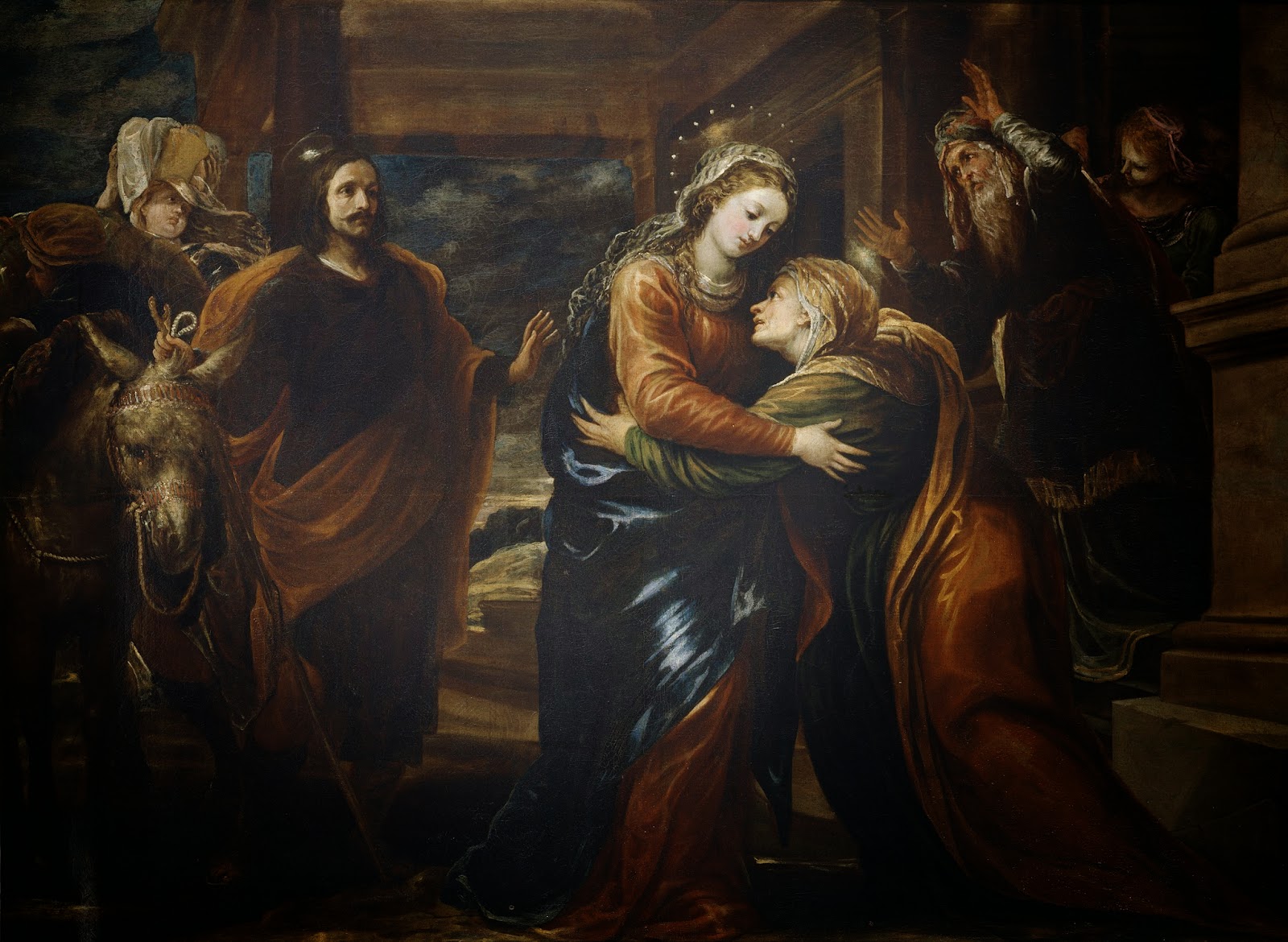
Rizi was an artist of the Spanish High Baroque from a family of artists who originally hailed from Bologna in Italy
In his day he was one of the most influential Spanish artists of his time especially of religious works. He was painter to the Spanish court and the Cathedral of Toledo
He was also an accomplished stage designer
In this work we see richness of colour, movement, theatricality, flamboyance and drama
"In those days Mary arose and went with haste into the hill country, to a city of Judah, and she entered the house of Zechariah and greeted Elizabeth. And when Elizabeth heard the greeting of Mary, the babe leaped in her womb; and Elizabeth was filled with the Holy Spirit and she exclaimed with a loud cry, 'Blessed are you among women, and blessed is the fruit of your womb!"' (Lk 1:39-42)
She goes to help her elderly cousin who is about to give birth. In Mary we recognize the figure of the Church which, through her works of mercy and charity, brings Christ to the world.
"Immediately after the narration of the Annunciation, the Evangelist Luke guides us in the footsteps of the Virgin of Nazareth towards "a city of Judah" (Lk. 1:39). According to scholars this city would be the modern Ain Karim, situated in the mountains, not far from Jerusalem.
Mary arrived there "in haste," to visit Elizabeth her kinswoman. The reason for her visit is also to be found in the fact that at the Annunciation Gabriel had made special mention of Elizabeth, who in her old age had conceived a son by her husband Zechariah, through the power of God: "your kins woman Elizabeth in her old age has also conceived a Son; and this is the sixth month with her who was called barren. For with God nothing will be impossible" (Lk. 1:36-37).
The divine messenger had spoken of what had been accomplished in Elizabeth in order to answer Mary's question. "How shall this be, since I have no husband?" (Lk. 1:34) It is to come to pass precisely through the "power of the Most High," just as it happened in the case of Elizabeth, and even more so.
Moved by charity, therefore, Mary goes to the house of her kinswoman."
The mystery of the Ascension of Christ is not easy to depict in art
Early medieval manuscripts depict apostles looking into the air. All the rest of us see is a pair of feet as below
The Master of the Dresden Prayerbook (active: about 1465 - about 1515)
f. 228r: The Ascension of Christ (Ascension Day)
From The Breviary of Queen Isabella of Castile
Add MS 17738, f. 228r
c. 1485
Parchment
230 x 160 mm
The British Library, London
In his scholarly and erudite way Pope Benedict XVI threw light on the Mystery of the Ascension of Christ in a homily at Cassino on Sunday, 24 May 2009 which perhaps shows that Tinsley had a greater understanding of this great Mystery than many others have had
""You shall receive power when the Holy Spirit has come upon you; and you shall be my witnesses in Jerusalem and in all Judea and Samaria and to the end of the earth" (Acts 1: 8).
With these words, Jesus took his leave of the Apostles, as we heard in the First Reading. Immediately afterwards the sacred Author adds that "as they were looking on, he was lifted up, and a cloud took him out of their sight" (Acts 1: 9).
This is the mystery of the Ascension that we are celebrating today.
But what do the Bible and the Liturgy wish to tell us by saying that Jesus "was lifted up"?
We cannot understand the meaning of these words from a single text or from a single book of the New Testament but rather by listening attentively to the whole of Sacred Scripture. In fact the verb "to lift up" was originally used in the Old Testament and refers to royal enthronement.
Thus Christ's Ascension means in the first place the enthronement of the Crucified and Risen Son of Man, the manifestation of God's kingship over the world.
However, there is an even deeper meaning that is not immediately perceptible.
In the passage from the Acts of the Apostles it is said first that Jesus was "lifted up" (v. 9) and then it says "taken up" (v. 11).
The event is not described as a journey to on high but rather as an action of the power of God who introduces Jesus into the space of closeness to the Divine. The presence of the cloud that "took him out of their sight" (v. 9), recalls a very ancient image of Old Testament theology and integrates the account of the Ascension into the history of God with Israel, from the cloud of Sinai and above the tent of the Covenant in the desert, to the luminous cloud on the mountain of the Transfiguration.
To present the Lord wrapped in clouds calls to mind once and for all the same mystery expressed in the symbolism of the phrase, "seated at the right hand of God".
In Christ ascended into Heaven, the human being has entered into intimacy with God in a new and unheard-of way; man henceforth finds room in God for ever. "Heaven": this word Heaven does not indicate a place above the stars but something far more daring and sublime: it indicates Christ himself, the divine Person who welcomes humanity fully and for ever, the One in whom God and man are inseparably united for ever.
Man's being in God, this is Heaven. And we draw close to Heaven, indeed, we enter Heaven to the extent that we draw close to Jesus and enter into communion with him.
For this reason today's Solemnity of the Ascension invites us to be in profound communion with the dead and Risen Jesus, invisibly present in the life of each one of us."